What Are the “River” and “Palace” in Xiangqi (Chinese Chess)?
Chess board of Chinese chess (xiangqi) has two very unique features: the river and the palace. There's the river, which is an open area in between the two sides, and then each palace is a 3×3 area — with the general and advisors being restricted to certain movements. The two features influence on pieces' movement, attacks' development and the protection of the player's Generals.
If you are new to xiangqi, it will help you to understand these two aspects, which will help you to follow the rules better. Here you will learn the position of the river and the palace, what pieces they move, what they mean to a player strategically and how they interact in a game.

What is the ‘River' (河界) in Chinese Chess?
Defining and locating the River
The board of xiangqi is a standard one, which is 9 by 10, with 90 intersection points. Xiangqi is different from Western chess in that the pieces are not placed on the squares but on the intersections of the lines of the board.
The open band (between the 5th and 6th horizontal lines) is the river. It splits the board into two, with 45 intersection points on each side. Red plays first, Black plays second.
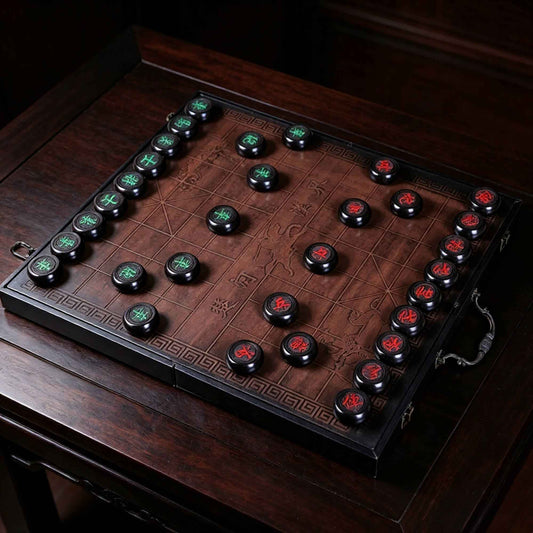
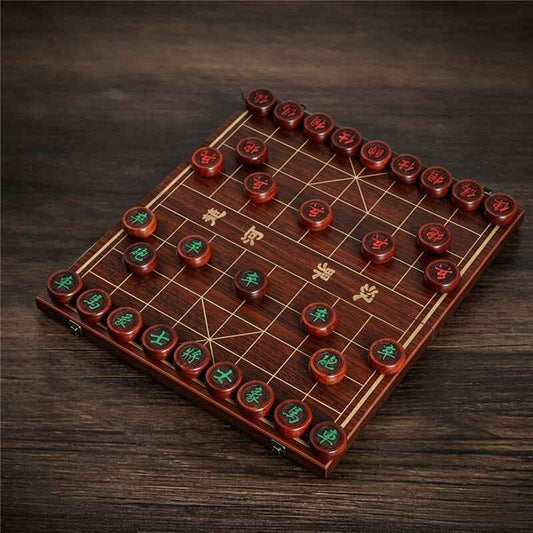
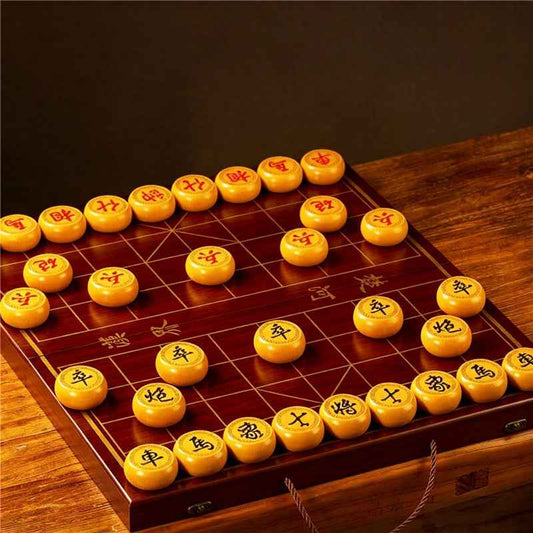
Numerous ancient boards have the Chinese characters 楚河 (Chǔ Hé - "Chu River") and 漢界 or 汉界 (Hàn Jiè - "Han Border") overlaid on this space. The lettering and calligraphy will change according to the design of the board and some newer boards will feature different decoration. Such inscriptions will have no rules changing effect and are strictly symbolic.
What is the shape of the River on the board?
The river is NOT a row of intersections that can be played on; rather, it is a gap between the two halves. There are nine vertical lines, with seven of them being divided at the river and the two extreme verticals being extended across the board.
The pieces of xiangqi are placed only on intersections with no points in the river where a piece can stop. A piece of crosses the river, going from an intersection on one side to an intersection on the other.
The difference for those used to playing western chess is significant: In the middle of the board there are no squares that the pieces can move to.
The question is what does "Crossing the River" mean?
A piece is "crossed" when it is on the opponent's side of the board. This is particularly significant for soldiers since their mobility might be affected when crossing.
Just because a piece crosses the river doesn't make it stronger, but may lead to new attack possibilities. A soldier is able to move sideways, and a chariot, horse or cannon may move as it normally would.
The effect that the River has on each piece
The river has an immediate impact on the flow of two pieces, the soldiers and the elephants. Other pieces may move over it freely, as per their regular movement rules.
| Piece | River rule | Palace rule |
|---|---|---|
| Soldier (兵/卒) | Moves forward one point at a time before crossing. After crossing, it may also move one point sideways. It can never move backward. | No restriction |
| Elephant (相/象) | Cannot cross the river and must remain on its own side. | No palace restriction, but it can move only to designated points on its own half |
| Advisor (仕/士) | Cannot cross the river under normal play because it is confined to the palace. | Must remain inside the palace and move one point diagonally along its marked lines |
| General (帅/将) | Cannot cross the river under normal play because it is confined to the palace. | Must remain inside the palace and move one point horizontally or vertically |
| Horse (马) | Can cross freely. | No restriction |
| Chariot (车) | Can cross freely. | No restriction |
| Cannon (炮) | Can cross freely. | No restriction |
There are two movement rules which are useful to understand.
An elephant moves exactly 2 points diagonally: The elephant's eye. If another piece is already on the intermediate location, then the elephant can't make that move. This is called "blocking the elephant's eye.
The horse's leg: A horse moves in L shape, but if a piece is on the next point of the move in the first orthogonal direction, then it is blocked from that move.
There's a different restriction on the cannon. It is not captured when traveling, but travels like a chariot—must jump over exactly one intervening piece to be captured.
These pieces don't obstruct the river. They can move according to their own rules, and the position of other pieces.
It is not possible to promote in xiangqi. When it enters the opponent's back rank it may not move forward and can move sideways within the legal bounds. A soldier can be tactically significant even in the lowliest rank, by limiting the enemy general and/or by helping an attack.

Why does a Xiangqi Board have a River?
With Chu and Han, Historical Association is the name of the game
The characters 楚河 and 汉界 allude to the Chu Han Contention (or struggle), which was a battle between two warlords – Xiang Yu of Chu and Liu Bang of Han – after the collapse of the Qin dynasty. This battle was fought in the late 3rd and early 2nd century BCE, and was won by Liu Bang.
The rivalry is linked with an agreement to establish an area boundary along the canal called Honggou, in Chinese history. The episode was a part of the historical memory in China.
But the history of the Chu-Han Contention and the river on the xiangqi board is interesting culturally, but not necessarily a definite history. The inscriptions reference Chu and Han, but cannot be deciphered as evidence that the board was meant to be a representation of the Hong Canal.
There is still some debate surrounding the origins of xiangqi. The easily recognised shape evolved over a long time and it is not historically reliable to credit any particular invention to the Han general Han Xin as is commonly told with its invention.
What do you think the river does?
What is important in the game is the river, whether it is the result of the lettering, or the actual river.
First of all it forms a definite barrier between the two armies. Each player starts on a different side and has to make their pieces make an attack into the contested areas.
Secondly, it confines the elephant to one half of the board. This causes the elephant to be mostly defensive and is different from others like horse, chariot and cannon which can move all over the board.
Thirdly, the river affects the way soldiers move. Before crossing, a soldier can only move forward. Once across, it also can move sideways! When soldiers go forward they can never come back; going across the river is a decision that can lead to new opportunities, but at the same time to a new threat of attack.
The River Matters Tactically
River areas have significance in the area of control and providing attacking opportunities. Chariots can be used to move pieces into files to put pressure on the opponent, cannons can be used to threaten pieces on the board, and soldiers can be used to move into the opponent's squares of defense.
There are a few traditional terms used in xiangqi which refer to the areas around the river where the chariots are placed:
- 巡河车 (xún hé chē): A car which traveled the bank of the river.
- 骑河车 (qí hé chē): Chariot placed on the riverbank on the other side of the river.
Translations are also not consistent, and you can get some insight if you learn the Chinese terms used for the game when reading books about xiangqi or learning annotated games.
When playing near the river, controlling the files can be very useful to inflict damage on enemy forces, assist the advance of a soldier or provide a point of entry to an attack. The optimal plan is dependent on where the other pieces are and lackings in the opponent's position.
A soldier who crosses the river can increase his/her movement options, but can also be a target. Likewise, a chariot which is far advanced can put the enemy to a disadvantage and be open to counter attack. The value of a river position therefore cannot be determined from just the crossing piece, but must be determined as a whole board value.
In the Chinese game of Chess, what is the "Palace" (九宫)?
The Palace is the place where the king sits and resides
Each side is a palace that is a 3x3 area with 9 intersection points. There are a total of 18 points in the two palaces.
The palace is located in the center of the board in the middle 3 files and 3 ranks next to the back edge of each player. The area where the general and advisors can be located and where the general should stay during the game.
Though the palace is commonly depicted as a square with diagonal lines, it is indeed a part of the same intersection based board that all the pieces of xiangqi use. The palace markings do not refer to pockets of special restriction on movement but to restrictions in movement.
The Diagonals and the X Pattern are the two most common types of pattern
The palace has two X's, which intersect diagonally inside the palace. These lines are significant since the advisors move diagonally along them.
These 9 palace points can be broken down into 3 groups:
- Center point: The point where the diagonals intersect.
- Corner points: The four endpoints of the diagonal lines.
- Edge points: The 4 points at the middle of the sides.
The general starts out in the middle square of the rear row. The two advisors take up their positions on the two points next to the general, on the back rank.
Knowing where the moves are placed makes it easier for the novice to see where the moves can go in the palace without having to memorize individual moves in each palace.

What Pieces Can't be Played in the Palace?
Only the movement of the general and advisor are limited to the palace.
The general (帅/将) can walk one step towards its right or down, and must stay inside the 9 palace points. Involved in no movement for diagonal.
The advisor (仕/士) walks diagonally one point on the line marked on the palace. It's not allowed to leave the palace, so it can only be placed in 5 locations: the center and the 4 corners.
The elephant, horse, chariot, cannon and soldier are not to be found in the palace. Enemy pieces can move into the palace as per their normal movement if they can reach the palace with their normal movement rules.
The palace allows OPPOSING pieces, but not the general and the advisors to move about.
What is the “Flying General” Rule?
The two generals can't be opposite one another in the same vertical file without a piece in between, according to the flying general rule.
No two generals can be on the same file with no piece in between them, or it is an illegal position. A player will not be allowed to take a step that would put the two generals in this direct conflict.
This rule not only applies to the general's movement, but to others as well. If to move away would reveal its own general, a piece in between the generals might not be able to get out. But there are other legal options that can be made that will maintain the blockage or remove the threat.
The easiest part of the lesson for beginners is to simply review first if a piece is moving from a file of the two generals before deciding if the piece should be moved.
The flying general rule is also applicable to endgame tactics. An open file between the generals can limit their movement and impact their options for defense or attack.
Why does a Xiangqi Board have a Palace?
The Palace's Design Principles
The general is restricted to nine points in the palace, and it is one of his major concerns throughout the game. Players are required to defend these points with their other pieces, and to set up threats against the opposing general.
This limitation sets up the attacking configuration which is unique in xiangqi. The general is not allowed to move across the whole board, so the attackers will have to find ways to limit the squares the general has available, coordinate their pieces and overcome the opponent's defenses.
The elephants defend the palace from the other side while the advisors defend from within the palace. They have to be controlled in movement and defensive formation and exchanges may become significant as the game progresses.
The Palace's influence on Checks and Checkmates
The palace is an important place to attack or to defend because the general can barely move. There are many ways in which the checkmate is accomplished, such as blocking its off-shots, or by blocking or combining pieces so that the general cannot escape.
The horse-behind-cannon mate (马后炮) is a popular tactic. This form of attack is one in which the horse and cannon act as a mating threat. The combination is dangerous and depends on the position, but can be especially hazardous if the general isn't in many safe squares.
A player also needs to be able to tell the difference between 'chessmate' and 'no legal move'. As in normal xiangqi play, the player who cannot make a legal move loses the game, whether or not the general is in check. As opposed to Western chess, stalemate is typically a draw.
It is best to use defenders to guard off key points in the palace.Advisors and elephants are good options to use for defending important points in the palace. There are elephant guards and advisors protecting the palace and the home position, which is diagonally located. But the optimal defensive configuration will vary depending on the opponent's pieces and threats.
The move of a defender away from the palace can cause an attacker to have an opportunity elsewhere but can also reduce the number of safe squares for the general. To consider that trade-off is a key aspect of xiangqi tactics.

What are the meanings of "Nine Palaces"?
Literally 九宫 (jiǔgōng) translates to "nine palaces" in Chinese. It also exists in other traditional and cultural diagram systems in Chinese culture, such as the 3×3 magic square Luoshu.
The layout of the xiangqi palace is the same as the one found in the familiar 3×3 format, but this is not sufficient evidence for a direct historical link. If there is no documentation to back it up, it's safer to talk about how similar the palace is than to say it was a direct copy of another traditional system.
The most essential aspect of the game when learning is the role of the palace: the area which the general can move around in, and the area that will be the defensive center of the game for the general and advisors.
How the River and the Palace Work Together
River vs. Palace: Key Differences
| Feature | River (河界) | Palace (九宫) |
|---|---|---|
| Location | Between the fifth and sixth horizontal lines | The middle three files and the three ranks closest to each player's back edge |
| Size | An open gap with no playable intersections | Nine intersection points per palace |
| Visible markings | Often displays 楚河 and 汉界 | Two diagonal lines forming an X |
| Main purpose | Separates the two sides and marks the frontier | Defines the movement area of the general and advisors |
| Pieces directly restricted | Soldier and elephant | General and advisor |
| Core rule | Soldiers gain sideways movement after crossing; elephants cannot cross | The general and advisors must remain within the palace |
| Strategic role | Creates opportunities for advancing and attacking | Defines the general's defensive area and many checkmate patterns |
The influence of the shapes on attack and defense
The river and the palace are complementary and fulfill different functions.
The river is the dividing line between the two sides. When crossed, soldiers acquire new movement options; other pieces can then move into enemy territory to generate threats.
The general's movement area is limited to the palace. The attackers attempt to block the squares the general can move to, the defenders attempt to protect the palace and prevent checkmate.
These features effect on various parts of a game. Players start developing pieces and play for valuable lines and positions in the opening. During the middle game they seek to combine their attacks and take advantage of any vulnerabilities. The palace may play an important role during the endgame, when the few remaining pieces try to defend the king or to hold their opponent at bay.
Knowing this, we can better comprehend the nature of both spaces and why xiangqi is a combination of open-board maneuver and precise attacks on a limited target.
Typical beginner's inquiries concerning the River and the Palace.
Is it possible for Pieces to be still in the river?
No. There are no intersections of the river for play. Pieces cross it by crossing from one side to the other as they normally cross.
Which Pieces Can Cross the River?
SOLDIERS, HORSE, CHARIOT, CANNONS are allowed to cross the river. It is impossible for elephants to cross it. The general and advisors stay on their own side as they are stuck inside the palace.
Can the Soldier go back down the road after crossing the river?
No. No soldier can go backwards. It advances forward 1 point before crossing the river. On the cross, it can cross and go one point forward, or one point sideways, but as long as it is legal.
Is it possible to promote a soldier in Chinese chess?
No. promotion is not allowed in Xiangqi. A soldier, once reaching the opponent's back rank, cannot move any further but can move sideways.
Will the General leave the Palace?
No. Throughout the game, the general has to stay within the 9 points of his palace.
How Advisors and Elephants Cross the River or Leave the Palace?
No. Advisors are to stay within their respective palace, and can move only one point along the marked lines in a diagonal direction. Elephants must stay on their own side of the river and they can only move 2 points diagonally (if not blocked).
If the Two Generals are facing each other?
Two generals in a line (along the same file) without any intervening piece is an illegal position. A player is not allowed to play a move which puts them into this position.
Does the river in Chinese Chess resemble anything in GO?
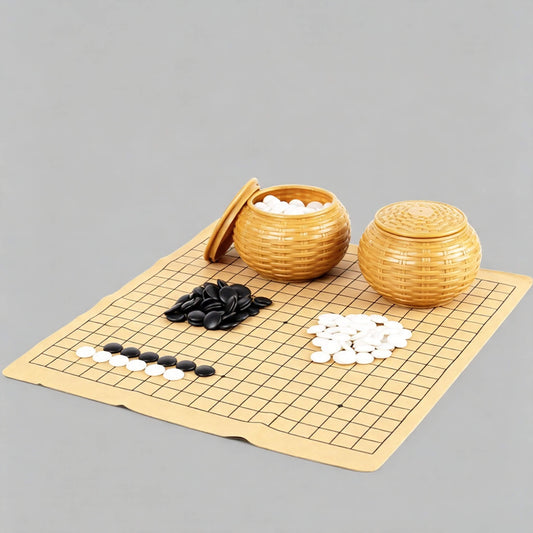
Not in terms of its rules and function. There is no river or palace in Go and the stones are not moved around the board, but placed on intersections. Intersections are used in both games, with two different strategic roles for the two boards.
Conclusion
Two important features of xiangqi are the river and the palace. The river is used to split the board in two, so that elephants cannot cross it, and provides the soldiers with extra movement options after they are in enemy territory. The palace isolates the general and advisors from the outside, it is also very important in defense and checkmate.
They are easier to follow with an awareness of these rules and it becomes easier to see how individual pieces move and attacks develop. The river determines where pieces can go and compete for space and the palace is the reason that protecting the general is so important in the game.
Using these concepts, try to implement them by playing a few games and focusing specifically on the soldiers crossing the river and the pieces controlling the escape points from the palace. After these ideas are understood, rules like the cannon's capturing screen, elephant's eye and horse's leg will be a breeze.