What Are the 6 Pieces in Chess? Names, Moves & Values
A standard chess game begins with 32 pieces on a board of 64 squares. These pieces belong to six types, each with its own movement rules, strengths, and role in the game. Learning how they move and interact is the first step toward understanding chess strategy.
This guide explains the names and starting positions of all six chess pieces, their approximate point values, special moves, and basic setup rules. It also covers the differences between bishops and knights and offers practical advice for choosing a chess set.
What Are the 6 Pieces in Chess?
The six types of chess pieces are the king, queen, rook, bishop, knight, and pawn. Each player starts with 16 pieces: one king, one queen, two rooks, two bishops, two knights, and eight pawns.
The objective of chess is to checkmate the opponent's king. Checkmate occurs when the king is under attack and no legal move can remove the threat. The king is never actually captured.

The Names of All 6 Chess Pieces
Chess uses algebraic notation to record moves. Each non-pawn piece has a letter: K for king, Q for queen, R for rook, B for bishop, and N for knight. The knight uses N because K is reserved for the king. Pawn moves have no piece letter; they are recorded using the destination square, such as e4.
| Piece | Notation Letter | White Symbol | Starting Squares for White |
|---|---|---|---|
| King | K | ♔ | e1 |
| Queen | Q | ♕ | d1 |
| Rook | R | ♖ | a1 and h1 |
| Bishop | B | ♗ | c1 and f1 |
| Knight | N | ♘ | b1 and g1 |
| Pawn | None | ♙ | a2 through h2 |
How Many Pieces Does Each Player Start With?
Each player starts with 16 pieces, giving a total of 32 pieces at the beginning of the game.
| Piece | Per Player | Both Players |
|---|---|---|
| King | 1 | 2 |
| Queen | 1 | 2 |
| Rook | 2 | 4 |
| Bishop | 2 | 4 |
| Knight | 2 | 4 |
| Pawn | 8 | 16 |
| Total | 16 | 32 |
White moves first, followed by Black. Otherwise, the two sides begin with the same types and numbers of pieces.
Major Pieces, Minor Pieces, Pawns, and the King
Chess players commonly group the pieces into several categories:
- Major pieces: The queen and rooks.
- Minor pieces: The bishops and knights.
- Pawns: The eight units that advance forward and can promote.
- The king: The piece whose safety determines the outcome of the game.
These categories describe conventional groups rather than a strict ranking of usefulness in every position. The queen and rooks are powerful long-range pieces, while bishops and knights are often worth about three pawns each.
In chess terminology, the word pieces sometimes refers specifically to the king, queen, rooks, bishops, and knights, excluding pawns. This explains why players may say that a position has only pawns remaining after all the other pieces have been exchanged.

How Do Chess Pieces Move?
Each chess piece follows a specific movement pattern under the FIDE Laws of Chess. The table below summarizes the basic rules.
The maximum-square counts refer to an otherwise empty board. They describe potential attacks from a particular square, not how many squares a piece can necessarily reach in an actual game.
| Piece | Direction of Movement | Range | Maximum Squares Attacked on an Empty Board |
|---|---|---|---|
| King | Horizontally, vertically, or diagonally | 1 square | 8 |
| Queen | Along ranks, files, and diagonals | Any distance | 27 |
| Rook | Along ranks and files | Any distance | 14 |
| Bishop | Along diagonals | Any distance | 13 |
| Knight | L-shape | Fixed jump | 8 |
| Pawn | Forward; captures diagonally | 1 square, or 2 on its first move | Varies |
How the King Moves
The king moves one square in any direction: horizontally, vertically, or diagonally.
It captures by moving onto an enemy piece, provided the destination square is not attacked by any opposing piece. A king may never move into check, even when the piece it would capture is otherwise undefended. For the same reason, two kings can never occupy adjacent squares.
When the king is attacked, the position is called check. The player must make a legal move that removes the threat. This can involve moving the king, capturing the attacking piece, or blocking the attack when the attacking piece and position allow it.
If no legal move can remove the check, the position is checkmate and the game ends.
The king usually needs protection during the opening and middlegame. In the endgame, however, it often becomes an active fighting piece, helping pawns advance and capturing enemy pawns.
How the Queen Moves
The queen combines the movement of a rook and a bishop. It can move any number of squares along a rank, file, or diagonal, provided the path is clear.
From the central square d4, a queen can attack up to 27 squares on an empty board. Its combination of long-range movement and flexibility makes it the most powerful piece by conventional material value.
A common beginner mistake is bringing the queen out too early. An opponent can develop pieces while attacking the queen, forcing it to move repeatedly. Developing knights and bishops first is often a more practical approach, although the best plan depends on the position.

How the Rook Moves
The rook moves any number of squares horizontally or vertically, but never diagonally. On an empty board, it attacks up to 14 squares from any square.
Rooks are particularly effective on open files, which are files without pawns of either color. They can also become powerful on the seventh rank, especially when attacking the opponent's pawns or restricting the enemy king.
For White, the seventh rank is rank 7; for Black, it is rank 2.
Two rooks that protect each other along the same rank or file are called connected rooks. They can exert considerable pressure, particularly when the position is open.
How the Bishop Moves
The bishop moves any number of squares along a diagonal, provided no piece blocks its path.
Each player starts with one light-squared bishop and one dark-squared bishop. A bishop remains on squares of the same color throughout the game, so it cannot directly control squares of the opposite color.
The bishop pair can influence both square colors and is often an advantage in open positions, where long diagonals are available. Its practical value depends on the pawn structure and the other pieces on the board.
A bishop may be less effective when its own pawns block its diagonals. This is one reason chess players distinguish between a good bishop and a bad bishop.
How the Knight Moves
The knight moves in an L-shape: two squares in one direction and then one square at a right angle. It can jump over intervening pieces, whether they belong to the same player or the opponent.
A knight in the center can attack up to eight squares on an empty board, while a knight in a corner can attack only two. This explains the familiar chess saying, "A knight on the rim is dim."
Knights are especially useful in positions where pawns block the paths of bishops and rooks. They can also create forks, attacking two or more enemy pieces simultaneously.
A knight always moves from a light square to a dark square, or vice versa. Unlike a bishop, it can eventually reach squares of either color.
How the Pawn Moves
The pawn is the most restricted piece in terms of movement, but it plays a major role in chess strategy.
A pawn normally advances one square straight forward. On its first move, it may advance two squares if both squares ahead are empty. Unlike other pieces, a pawn captures one square diagonally forward rather than moving straight ahead to capture.
A pawn cannot move backward. If an enemy piece stands directly in front of it, the pawn cannot capture that piece or move through it.
Pawns shape the position by controlling squares, restricting enemy pieces, and creating paths for their own pieces. A passed pawn—one that cannot be stopped or captured by an enemy pawn on its own or an adjacent file as it advances toward promotion—can become particularly dangerous.
The chess master François-André Danican Philidor famously described pawns as the soul of chess, reflecting their importance to positional strategy.
Which Chess Pieces Can Jump Over Other Pieces?
Only the knight can jump over intervening pieces during an ordinary move.
The queen, rook, and bishop cannot move through occupied squares. Pawns also cannot move through pieces, and the king moves only one square at a time, subject to the rules governing check.
Castling is a special move involving the king and a rook, but neither piece jumps over the other. The king moves two squares toward the rook, and the rook moves to the square the king crossed.
This is why a knight can leave its starting square on the first move without requiring a pawn to move out of the way.
Can Pawns Move Backward?
No. Pawns can only move forward, and no legal pawn move allows one to retreat.
Because every pawn move is irreversible, advancing a pawn can create lasting weaknesses. Moving a pawn may open a line for a bishop or rook, but it can also leave squares behind it that enemy pieces can occupy.
A pawn that reaches the opposite end of the board must be promoted to a queen, rook, bishop, or knight of the same color. This possibility makes advanced pawns particularly important in endgames.
What Are the Special Moves in Chess?
Chess has three special rules that beginners should learn early: castling, en passant, and pawn promotion. Each changes the usual movement or capture rules in a specific way.
Castling: How the King and Rook Move Together
Castling is a special move involving the king and one rook. It helps improve king safety and can bring a rook closer to the center.
The king moves two squares toward the chosen rook, and the rook moves to the square the king crossed. Kingside castling is written as O-O, while queenside castling is written as O-O-O.
| Type | Notation | White King | White Rook | Black King | Black Rook |
|---|---|---|---|---|---|
| Kingside | O-O | e1 → g1 | h1 → f1 | e8 → g8 | h8 → f8 |
| Queenside | O-O-O | e1 → c1 | a1 → d1 | e8 → c8 | a8 → d8 |
Castling is legal only when all the following conditions are satisfied:
- Neither the king nor the chosen rook has moved earlier in the game.
- All squares between the king and the chosen rook are empty.
- The king is not currently in check.
- The king does not cross a square attacked by an opposing piece.
- The king does not finish on a square attacked by an opposing piece.
The rook is allowed to be under attack. During queenside castling, the b-file square must be empty, but the king does not pass through it, so that square may be attacked.
Players often castle during the opening to improve king safety and connect their rooks. However, the best timing depends on the position, and castling is not always the right choice.

En Passant: The Special Pawn Capture
En passant is French for "in passing." It is a special pawn capture that is available only immediately after a qualifying pawn move.
The rule applies when a pawn advances two squares from its starting position and lands beside an enemy pawn. The enemy pawn may capture it as if it had advanced only one square, moving diagonally to the square the pawn passed over.
The right to capture en passant expires if the player does not use it on the very next move.
The rule prevents a pawn from avoiding a possible capture simply by advancing two squares past an opposing pawn. It is worth learning before playing a tournament, because the resulting capture can initially look unusual to beginners.
Pawn Promotion: What Happens When a Pawn Reaches the Last Rank?
When a pawn reaches the farthest rank, it must be promoted immediately to a queen, rook, bishop, or knight of the same color.
White promotes on rank 8, while Black promotes on rank 1. The pawn cannot remain a pawn or become a king.
Promotion can occur when a pawn advances straight forward or captures an enemy piece diagonally onto the last rank.
Most promotions are to queens because the queen is the most powerful piece by conventional material value. However, choosing a rook, bishop, or knight is called underpromotion and can be useful in certain positions.
For example, a knight promotion can give check in a way that a queen promotion cannot. Underpromotion can also help avoid stalemate or achieve a specific tactical result.
A player can theoretically have up to nine queens at once: the original queen and eight promoted pawns. This is extremely rare in practical games.
How Much Is Each Chess Piece Worth?
Chess players use a conventional point system to estimate the relative material value of pieces. It helps beginners evaluate exchanges, but it is not an official rule and cannot replace positional judgment.
Chess Piece Values: A Quick Reference Table
The traditional material scale assigns one point to a pawn, three points to a knight, three points to a bishop, five points to a rook, and nine points to a queen.
The king has no standard material value because it cannot be captured. Its importance is determined by the rules of the game, not by a conventional point score.
| Piece | Standard Approximate Value |
|---|---|
| Pawn | 1 |
| Knight | 3 |
| Bishop | 3 |
| Rook | 5 |
| Queen | 9 |
| King | No standard material value |
The starting army has 39 points of conventional material per side:
- Eight pawns: 8 points
- Two knights: 6 points
- Two bishops: 6 points
- Two rooks: 10 points
- One queen: 9 points
These totals are useful when comparing material after exchanges. However, two positions with the same material count can have very different strategic or tactical evaluations.
Why Piece Values Matter When Trading Pieces
Piece values help players decide whether an exchange is favorable.
For example, trading a knight worth approximately three points for a rook worth five points usually wins the exchange, giving a material gain of about two points. Trading a rook for a bishop usually loses the exchange unless there is a compensating benefit.
| Trade | Points Given | Points Received | General Assessment |
|---|---|---|---|
| Rook for bishop | 5 | 3 | Usually loses material |
| Bishop and knight for rook and pawn | 6 | 6 | Equal by the basic scale |
| Queen for two rooks | 9 | 10 | Materially favorable for the rooks, but position-dependent |
| Knight for three pawns | 3 | 3 | Equal on paper; the position determines the practical value |
A player who is ahead in material often benefits from exchanging pieces because doing so can reduce the opponent's attacking chances. A player who is behind may prefer to keep more pieces on the board and seek tactical opportunities.
These are general guidelines, not absolute rules. A favorable exchange on paper can still be a mistake if it allows checkmate or gives the opponent a decisive passed pawn.
Why Piece Values Change Depending on the Position
The standard values are only starting points. A piece's actual usefulness depends on its mobility, the pawn structure, king safety, and available tactical opportunities.
A bishop can be especially powerful in an open position with long diagonals. A knight may be more effective in a closed position where pawns block the bishops' paths.
The bishop pair is often an advantage when both bishops have open diagonals and can influence both square colors. However, its value depends on the position.
A knight on a protected central outpost can be worth more than its usual three points. A rook trapped behind its own pawns may be less effective than a well-placed bishop. A passed pawn can become increasingly dangerous as it approaches promotion.
Sometimes, sacrificing material is the correct decision. Giving up a queen or rook may be justified if it leads to checkmate or wins enough material in return.
Use the point values to begin evaluating a position, then consider what each piece can actually do.
What Is a Hanging Piece in Chess?
A hanging piece is a piece that can be captured because it is inadequately defended, often without sufficient compensation for the player losing it.
Hanging pieces are a common source of material loss, particularly among beginners. The most useful habit is to check the board before every move:
- Which of your pieces are attacked?
- Which of your pieces are defended?
- Does your intended move leave a piece undefended?
- Can your opponent win material with a capture or tactic?
Also check the opponent's pieces. A piece that appears protected may be overloaded, meaning it has too many defensive responsibilities, or it may be vulnerable to a tactical combination.
Learning to recognize hanging pieces is a practical way to reduce avoidable mistakes.

What Is the Strongest Piece in Chess?
The answer depends on what you mean by strongest. The queen is the most powerful piece by conventional material value, the king is the most important piece under the rules, and the pawn has the potential to promote into a stronger piece.
Why the Queen Is Usually the Most Powerful Piece
The queen is generally considered the strongest piece because it combines the movement of the rook and bishop. It can travel along ranks, files, and diagonals, making it effective in both attack and defense.
With a conventional value of nine points, the queen is worth more than any other piece. Its mobility allows it to attack multiple targets, support mating threats, and defend important squares.
However, the queen is not invulnerable. Bringing it out too early can expose it to attacks from developing pieces. Trading it for a lesser piece is usually unfavorable unless the exchange leads to checkmate or another substantial advantage.
Why the King Is the Most Important Piece
The king is the most important piece because checkmate ends the game. A player can have a large material advantage and still lose if the opponent delivers checkmate.
During the opening and middlegame, king safety is often a priority. In the endgame, the king can become an active piece, supporting passed pawns and capturing enemy pawns.
A lone king cannot force checkmate against another lone king. Most basic checkmating positions require the king to work with a queen, a rook, or a suitable combination of other pieces.
Why Pawns Can Become Powerful Through Promotion
Pawns are the lowest-valued pieces on the conventional material scale, but they can transform into queens, rooks, bishops, or knights.
A passed pawn can force the opponent to devote pieces to stopping it. In many endgames, the result depends on which side can promote a pawn first.
This is why pawn moves deserve careful consideration. Giving up a rook or bishop to stop a dangerous passed pawn may be the correct decision if it prevents promotion or secures a favorable position.
What Is the Difference Between a Bishop and a Knight?
Bishops and knights are both assigned a conventional value of three points, but they move differently and perform better in different types of positions.
| Feature | Bishop | Knight |
|---|---|---|
| Movement | Diagonals, any distance | L-shaped jump |
| Square color | Stays on one color | Alternates colors with each move |
| Can jump over pieces | No | Yes |
| Maximum squares attacked on an empty board | 13 | 8 |
| Often strongest in | Open positions | Closed positions |
| Common limitation | Restricted to one square color | Shorter range and slower long-distance travel |
Movement, Mobility, and Piece Characteristics
A bishop travels along diagonals and can influence distant squares when its paths are open. A knight moves in a fixed L-shape and can jump over intervening pieces.
Because a bishop stays on one square color, it cannot directly control squares of the opposite color. A knight can eventually reach either color, although it may need several moves to cross the board.
Knights are also particularly effective at forks because they can attack multiple targets at once, sometimes threatening pieces that cannot easily escape.
In short, bishops excel at long-range diagonal control, while knights are effective at navigating crowded positions and attacking from unexpected angles.
When Bishops Are Better Than Knights
Bishops often perform well in open positions, where fewer pawns block their diagonals. They can quickly influence different parts of the board and put pressure on distant targets.
The bishop pair can be especially useful when both bishops have open lines. A bishop may also become powerful when it controls squares that the opponent's pieces cannot easily challenge.
A bad bishop is one whose own pawns restrict its activity, often because they occupy squares of the same color as the bishop. Such a bishop may have difficulty finding useful diagonals.
A fianchetto is another common way to develop a bishop. The bishop is placed on g2 or b2 for White, or g7 or b7 for Black, where it can influence a long diagonal toward the center.
When Knights Are Better Than Bishops
Knights often perform well in closed positions, where pawn chains restrict the movement of bishops.
A knight can also be strong on an outpost: an advanced square that cannot easily be challenged by an enemy pawn. A well-supported knight on such a square can restrict the opponent's pieces and create tactical threats.
Knights are particularly useful in positions with many pieces, where their ability to jump over obstacles creates opportunities for forks and unexpected attacks.
Neither piece is universally better. The pawn structure and available squares usually matter more than the basic three-point valuation.
How Beginners Can Use Bishops and Knights Effectively
Beginners should generally develop their minor pieces early, often before bringing the queen into the game.
Knights commonly develop to f3 and c3 for White, or f6 and c6 for Black, although the best squares depend on the opening.
Try to develop both bishops and knights toward useful squares, avoid unnecessary exchanges, and consider how the pawn structure affects each piece.
When playing with bishops, look for open diagonals. When playing with knights, look for protected outposts and tactical forks. These practical ideas are more useful than treating the three-point value as an absolute rule.
How Do You Set Up Chess Pieces Correctly?
Setting up a chessboard correctly is essential for playing a legal game. The easiest way to avoid mistakes is to check the board orientation, back rank, queen placement, and pawn rows in that order.
Place the Board With a Light Square on the Right
The board must be positioned so that the bottom-right square from each player's perspective is light-colored.
This is often remembered as "light on the right." If the board is rotated incorrectly, the pieces will not occupy their standard starting squares.
Check the board orientation before placing the pieces.
Arrange the Back Rank in the Correct Order
The back rank contains the king, queen, rooks, bishops, and knights.
From White's left to right, the correct order is:
Rook, Knight, Bishop, Queen, King, Bishop, Knight, Rook.
Black uses the same order from Black's own perspective.
| File | a | b | c | d | e | f | g | h |
|---|---|---|---|---|---|---|---|---|
| White back rank (rank 1) | Rook | Knight | Bishop | Queen | King | Bishop | Knight | Rook |
| White pawns (rank 2) | Pawn | Pawn | Pawn | Pawn | Pawn | Pawn | Pawn | Pawn |
| Black pawns (rank 7) | Pawn | Pawn | Pawn | Pawn | Pawn | Pawn | Pawn | Pawn |
| Black back rank (rank 8) | Rook | Knight | Bishop | Queen | King | Bishop | Knight | Rook |
Place the Queen on Her Own Color
The queen starts on a square of her own color:
- White queen: d1, a light square.
- Black queen: d8, a dark square.
The king occupies the adjacent central square: e1 for White and e8 for Black.
This simple rule helps prevent one of the most common setup mistakes.
Set Up the Eight Pawns
White's eight pawns occupy rank 2, while Black's eight pawns occupy rank 7.
Each pawn starts directly in front of a back-rank piece. Check that all eight pawns are present on each side before beginning the game.
Common Setup Mistakes
| Mistake | How to Spot It | How to Fix It |
|---|---|---|
| Board rotated incorrectly | Bottom-right square is dark | Rotate the board until the bottom-right square is light |
| King and queen swapped | White queen is not on d1 | Place the queen on d1 and king on e1 |
| Bishops and knights reversed | Knights are on c and f files | Place knights on b and g, bishops on c and f |
| Black pieces incorrectly arranged | Black queen is on e8 | Place the black queen on d8 and king on e8 |
A quick check of these four details will prevent most starting-position errors.

What Are Staunton Chess Pieces?
Staunton chess pieces are the familiar style of chessmen used in many modern chess sets. They have distinct shapes that make each piece easy to recognize during play.
The History and Recognition of the Staunton Design
The Staunton design was introduced in 1849 and became widely associated with the standard appearance of modern chess pieces. The design is named after Howard Staunton, the prominent English chess player who endorsed it.
The pieces have recognizable features: a cross on the king, a crown-like top on the queen, a mitre-shaped bishop, a horse's head on the knight, and a tower-like rook.
Their distinct silhouettes make it easier for players to identify pieces quickly and reduce confusion during a game.
Why Staunton Pieces Are Commonly Used in Competitive Chess
Staunton-style pieces are widely used in clubs, schools, and tournaments because they are recognizable and practical.
FIDE's equipment standards specify Staunton-style pieces for the competitions covered by those standards. The pieces should be easy to distinguish, stable on the board, and suitable in size and proportion.
For beginners, learning with a Staunton-style set also makes it easier to transition between home games, clubs, and tournament play.
How Do You Choose the Right Chess Pieces?
Choosing a chess set involves matching the pieces to the board, selecting suitable materials, and considering where the set will be used.
How to Match Chess Piece Size to Your Board
Chess pieces should fit comfortably on the squares without crowding neighboring pieces.
A common guideline is for the king's base diameter to occupy roughly 75–80% of the square width. This leaves enough room to move pieces without bumping into others.
FIDE's equipment standards specify a king height of 95 mm (about 3.75 inches) and board squares measuring 5–6 cm (about 2–2.4 inches) for the relevant competition equipment. These dimensions are useful references, but casual sets can use other sizes.
| King Height | Suitable Square Size | Typical Use |
|---|---|---|
| 3.0 in (7.6 cm) | 1.75–2.0 in | Small home boards and travel sets |
| 3.5 in (8.9 cm) | 2.0–2.25 in | Casual and club play |
| 3.75 in (9.5 cm) | About 2.0–2.4 in | Sets designed around common competition dimensions |
| 4.0 in (10.2 cm) | 2.5 in or larger | Large boards and display sets |
Always check the actual base diameter and square width rather than relying on king height alone.
Wooden vs. Plastic Chess Pieces
Wooden chess pieces often have a warm appearance and satisfying feel. Common materials include boxwood and various hardwoods. Quality wooden sets can be attractive for home use, but they may cost more and require care to avoid damage from impacts or changes in humidity.
Plastic pieces are generally more affordable, durable, and easy to maintain. Weighted plastic pieces are common in schools and chess clubs because they are practical for frequent play.
For everyday games, a good plastic set is often a sensible choice. Wooden pieces may be preferable if appearance, craftsmanship, and feel are important to you.
Choosing Chess Pieces for Home, Clubs, Tournaments, and Travel
The best set depends on how you plan to use it.
- Home: Choose a comfortable size and a material you enjoy handling.
- Clubs and schools: Durable, weighted plastic pieces are practical for frequent use.
- Tournaments: Check the event's equipment requirements, including piece style and board dimensions.
- Travel: Compact magnetic sets or roll-up boards are convenient when space is limited.
Not every tournament uses identical equipment rules, so check the organizer's requirements before buying a set specifically for competition.
What to Check Before Buying a Chess Set
Before purchasing a chess set, check the following:
- King height and base diameter: Make sure the pieces fit the board.
- Stability: Weighted pieces are often easier to handle and less likely to tip.
- Base protection: Felt or similar material helps protect the board surface.
- Piece recognition: Bishops, knights, and pawns should be easy to distinguish.
- Board contrast: The two square colors should be clearly different.
- Extra queen: An additional queen is useful when a pawn promotes and the original queen is still on the board.
These checks help ensure that the set is comfortable to play with and suitable for its intended use.
FAQ About Chess Pieces
How Many Chess Pieces Are There in Total?
A standard chess game starts with 32 pieces: 16 White and 16 Black. Each side has one king, one queen, two rooks, two bishops, two knights, and eight pawns.
The number of pieces decreases as captures occur. However, promotion can increase the number of queens, rooks, bishops, or knights during the game.
What Is the Weakest Piece in Chess?
The pawn is generally considered the weakest piece by conventional point value, worth one point. It has restricted movement and captures only diagonally forward.
However, pawns can promote to queens, rooks, bishops, or knights, making them particularly important in endgames.
A lone bishop or knight cannot force checkmate against a lone king, while two bishops can force checkmate with the help of their king.
Does a Pawn Have to Move Two Squares on Its First Move?
No. A pawn may advance one or two squares on its first move, provided the path is clear and the move is legal.
Moving two squares is optional. The best choice depends on the position and the player's plan.
Can the King Capture Other Pieces?
Yes. The king can capture an enemy piece on an adjacent square, provided the destination square is not attacked by any opposing piece.
Even if the target piece is undefended, the king cannot capture it if doing so would move the king into check.
Can You Have More Than One Queen in Chess?
Yes. A pawn that reaches the last rank can be promoted to a queen, even if the original queen is still on the board.
In theory, a player can have up to nine queens: the original queen and eight promoted pawns. This is extremely rare in practical games.
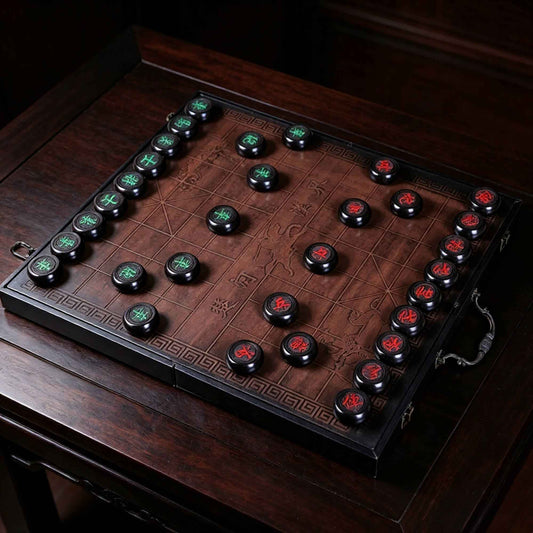
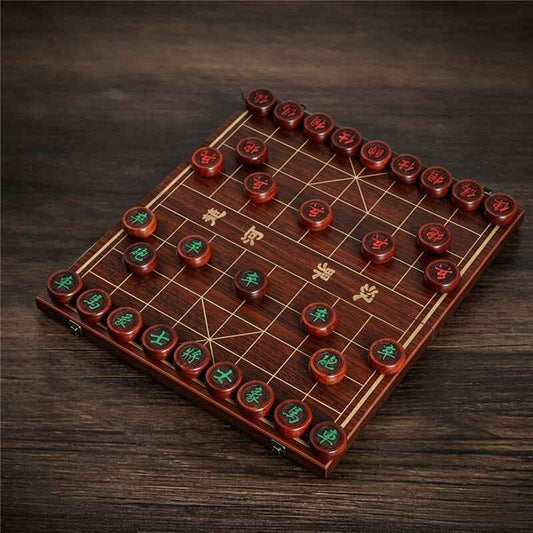
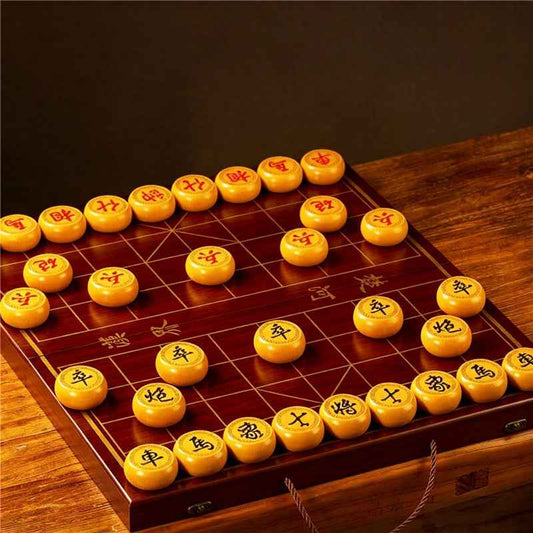
What Is the Difference Between Chess and Chinese Chess Pieces?
International chess and Chinese chess, known as xiangqi, both involve capturing opposing pieces and protecting a royal piece, but their boards and rules differ substantially.
Xiangqi has seven types of pieces: the general, advisor, elephant, horse, chariot, cannon, and soldier. Each side starts with 16 pieces, but the pieces are flat discs marked with Chinese characters and placed on the intersections of a 9-by-10 grid.
The board has a river across the middle and a palace for each general. The general is restricted to the palace, while the elephant cannot cross the river. The cannon has a distinctive capture rule: it must jump over exactly one intervening piece to capture a target.
| Feature | International Chess | Chinese Chess (Xiangqi) |
|---|---|---|
| Piece types | 6 | 7 |
| Pieces per side | 16 | 16 |
| Board | 8-by-8 squares | 9-by-10 intersections |
| Royal piece | King | General |
| Unique piece | No equivalent to the xiangqi cannon | Cannon captures by jumping over one piece |
| Knight and horse | Knight jumps over intervening pieces | Horse can be blocked by an adjacent piece |
Although the two games share some strategic ideas, their different movement rules mean that chess experience does not automatically translate into xiangqi expertise.
Conclusion
The six chess pieces—the king, queen, rook, bishop, knight, and pawn—form the foundation of the game. Learning their names, starting positions, movement rules, and approximate values helps beginners understand how chess works and why different pieces perform better in different situations.
Remember the basic material scale of 1–3–3–5–9 for pawns, knights, bishops, rooks, and queens. Use it as a guide rather than an absolute rule, because the value of a piece depends on the position.
Set up the board with a light square on the bottom right, place each queen on her own color, and learn the rules for castling, en passant, and promotion. With these fundamentals in place, you will be better prepared to recognize tactics, make sensible exchanges, and enjoy your games.