Is Shogi Harder Than Chess? Complexity, Rules & Learning
Though the more complex one is generally shogi, it is not the harder to get at of the two. In Shogi (Japanese chess) there are more pieces, a larger game tree, a larger board, and the drop rule allows the re-use of captured pieces. Chess is easier to learn the rules of, but has a much larger amount of opening and endgame theory. It is debatable what is “harder,” depending on one's definition of hard.
Shogi vs Chess in 30 Seconds: Which is Harder?
For those who only have a minute, here's the short answer. There are less pieces to learn in the first week and no dropping rule to learn, thus, it is easier to pick up chess in the first week. From the middle game onwards, shogi is typically more difficult to calculate due to the fact that captured pieces can be returned to the board and that there are significantly more legal moves. They are very hard disciplines in which to excel and neither is "easy" to any one who has attempted to achieve a high degree of amateur proficiency.
| Question | Easier game | Why |
|---|---|---|
| Learning the rules | Chess | Fewer piece types, no drops, and only pawns promote |
| Reading the pieces | Chess | Shogi pieces traditionally use kanji, although pictogram sets are available |
| Middlegame calculation | Shogi | Shogi generally has a higher branching factor and more tactical possibilities |
| Avoiding draws | Shogi | Draws are rare in professional play |
| Raw complexity | Shogi | Shogi has a substantially larger estimated game tree |
| Mastery | Neither | Both demand years of study and practice |

What is the difference between "harder" and "hard"?
People often ask if the game of Shogi is easier or more difficult than the game of chess, but here are four possibilities for what they're asking. Some difficulty with the rule of the game, which is the time required to get to know how everything is moving. Others refer to beginner difficulty, or the first twenty games as the most frustrating in the game. Some refer to mean computational difficulty, which is the number of positions a player or an engine has to consider. And some mean mastery difficulty, that is, how long it takes to reach a high level of mastery. These are not "combine and match" questions, and their answers have nothing to do with one another, and if you combine the answers to these questions you will get nowhere in your online argument regarding this.
Why Shogi and Chess are Different?
Chess and Shogi are distant cousins in the large family of chess-like games, which are rooted in the Indian and Asian chess traditions of ancient times. They have a similar family resemblance; there are two armies, a king that must be safeguarded, pieces that move in different ways and promotion rules. The differences, however, are greater than most of the beginner's might imagine and a number of them alter the way you think while completing almost every movement.
Active play, board and number of pieces
Chess is a game that is played on an 8 × 8 board using 16 pieces on each side (32 pieces all together). In Shogi, the players use 20 pieces each which are placed on a 9×9 board for a total of 81 squares. In the game of shogi, one king, one rook, one bishop, two gold generals, two silver generals, two knights, two lances and nine pawns are used per army. Unlike shogi, there is no queen in shogi, and for this reason, the rook and the bishop are considered to be high-value pieces. Like shogi, each piece is a flat wedge-shaped tile facing the opponent (as opposed to color) and the ownership of each piece depends on what direction it is facing.
The movements of the Pieces
In most chess sets, most pieces are able to move one square behind themselves and the queen moves like a rook and a bishop. The shogi pieces, in general, are more constrained, especially the minor pieces. The gold general can move one square in 6 directions; the silver general can move one square diagonally or straight forward; the knight can move only 1 square side to side and 2 square forward; and the lance can move straight forward any distance, but not backwards. The shogi pawn can move and capture one square forward, it can not double step or capture diagonally and is not like a chess pawn. Such restrictions leave each piece of shogi less powerful, and allow them to be arranged into fixed units that are very solid and can be very dangerous.
Winning Condition
The idea in both games is to checkmate the opponent's king. In chess, to checkmate a king is to attack it, and for it to not be able to move in any way. In the case of shogi, the idea is the same, but due to drops, the attacker has a much greater number of options when creating a mating net while the defender also has options to create new defenses through the use of piece in hand. Another famous special case of shogi is called tsume shogi, a type of mating problem which is commonly used for training purposes.
What does a player do with the pieces he captures?
Chess: A piece that is captured is removed from the game. In shogi the captured piece goes to the capturer's "hand" (mochigoma, which is typically translated as "pieces in hand") and may be placed as one of the capturer's own pieces on a subsequent game on a legal vacant square. It is this rule that is probably the most significant difference between shogi and chess. Changing pieces isn't as simple as it will be in chess, as the pieces you take can be weapons in your hands.

Promotion Rules
In chess there is only a promotion which usually occurs for pawns that reach the last rank. Promotion in shogi is possible for the following six pieces: the rook, bishop, silver, knight, lance and pawn. As soon as a piece moves into, through or out of the three farthest ranks (promotion zone), it may promote. In most situations it is not mandatory to promote but if the piece would otherwise have no legal move, for example a pawn or lance reaching the final rank or a knight reaching one of the final two ranks, then it is mandatory.
The rook is promoted to a dragon king, retains its rook movement and now gains a one-square diagonal step. A promoted bishop becomes a dragon horse (bishop move and an orthogonal step). The promoted pieces (silvers, knights, lances and pawns) all move like a gold general. A gold general or king will not promote!
Draw Rules
There are a number of reasons why a game of chess can go into a draw, such as a stalemate, threefold repetition, not enough material, the 50 move rule, and the players agreeing to draw. There are many less in Shogi.
Sennichite in shogi is when the same position (including the pieces in hand) is repeated four times and the player does the same piece the same time. In most professional contests, a repetition will then be followed by a second game with the players taking turns, or switching sides. The repetition of the "Perpetual Check" is a special case, if the player makes a 4-fold repetition by continuously checking he loses.
Another form of a shogi game that can be won if no checkmate is made is jishogi (impasse). This can be the result of the two kings entering the opponent's camp and the position is a result of the impasse rules. A point-count procedure then is used to decide if the game is replayed or ends.
In reality, the number of draws in the professional games is very small, typically 1-2% of games.
Shogi vs Chess: Core Rules Compared
| Feature | Shogi | Chess |
|---|---|---|
| Board | 9×9 (81 squares) | 8×8 (64 squares) |
| Pieces per side | 20 | 16 |
| Strongest piece | Rook / Dragon King | Queen |
| Piece movement | Mostly forward-oriented | Mostly bidirectional |
| Captured pieces | Reused by the captor through drops | Removed permanently |
| Promotion | Six piece types, three-rank zone | Pawn only, last rank |
| Pawn capture | Straight ahead | Diagonally forward |
| Common draw methods | Repetition and impasse | Stalemate, repetition, 50-move rule, insufficient material, agreement |
| Piece identification | By direction the tile faces | By color |
| Typical game length | About 110–115 plies in classic estimates | About 80 plies in classic estimates |
Shogi is generally regarded as more complex than chess, why?
It is not a matter of opinion that complexity is a thing in game theory. Commonly used metrics to compare games include branching factor, game length, state-space and game-tree complexity. In the following commonly mentioned parameters, shogi is usually considered more complicated than chess. Depending on the definitions and methods used, the relative difference is rather large, but the absolute figures will differ.
The Biggest Difference: Captured Pieces Can Be Dropped Back In
In chess, the number of pieces can only go down as the game goes on, and thus positions tend to be easier towards the endgame. Shogi is more like it: Captured pieces stay in play as pieces in hand and can be returned on the board with drops. An endgame in shogi can therefore be technically crowded and attackers can't be driven out of the game by previous exchanges.
This is one of the reasons why shogi games can be very tactical until the last.

What is Drop Rule (Mochigoma)?
The drop rule allows a player to instead of moving a piece on the board, remove one piece from their hand and place it on any empty board square (as long as it is legal). The dropped piece must be in its "normal" state and may not promote on the turn it is dropped, even if it falls within the promotion zone.
Not only does strong players use drops to defend, attack, fork, block lines, create mating threats, but it also changes the balance of a position. That is why strong players focus as much on what is in the players' hands as what is on the board, because one hand can make all the difference in evaluating a position.
Limits on Drops
However, there are a number of important restrictions to the drop rule.
The first is nifu, which means that you shouldn't place an unpromoted pawn on a file with another unpromoted pawn of the same colour.
The second rule is that a piece can't be dropped where it has no legal move on a future turn. This means that pawns and lances cannot be placed on the last rank and knights cannot be placed on the last 2 ranks.
There is a third rule, uchifuzume, which states that the delivery of checkmate by dropping a pawn is prohibited. A pawn drop which gives check is legal as long as it does not immediately checkmate the opponent.
In formal play, illegal moves mean the player loses the game; in casual games, they might have a different procedure.
How the calculation is multiplied by promotion
Any move into, within or out of the promotion zone can represent another decision as the player must decide to promote or not. Promoting a rook or a bishop is often good, but promoting a silver or a knight can sometimes be bad as the piece has movement options that the promoted gold-moving piece does not.
Together with drops, this makes for vastly different outcomes with small decisions on the timing and the placement of pieces.
Why Shogi Positions are so variable
Several factors layer over each other: The larger board, more pieces, drops, possible promotion, and numerous limited but overlapping movement options. All these make more options and work together to multiply the number of jobs to look at.
The evaluation of a position can go from good to bad very quickly when it happens at the right time. That's what makes Shogi exciting and that's what makes it hard to make accurate calculations.
Shogi vs Chess: State-Space Complexity and Game-Tree Complexity
The pair of measures that are generally used for comparison of games is standard, namely the number of legal positions (state-space complexity) and the number of possible games (game-tree complexity).
Classic estimates put shogi substantially above chess:
| Metric | Chess | Shogi |
|---|---|---|
| Average branching factor | About 35 | About 80 |
| Average game length (plies) | About 80 | About 115 |
| State-space complexity | About 10^44–10^47 | About 10^71 |
| Game-tree complexity | About 10^123 | About 10^226 |
These are best estimates and not actual counts. The shogi figures are related to the early research on computer-shogi by Iida, Sakuta and Rollason and the classic chess estimates are based on the research of Claude Shannon and subsequent game-complexity analysis. Iida, Sakuta, and Rollason pointed out, in particular, that the game-tree of shogi is much more complicated than that of chess.
In chess, more sophisticated position-counting studies have yielded more precise estimates of the number of legal positions, so this may account for some differences of state space estimates. It is not essential to the point that the number be exactly 15, simply that it be 15 times as much.
Is the more complex, the more difficult?
Not automatically. The size of the game is called complexity, and the human difficulty of playing the game well is called the difficulty. Even if you have an enormous tree, a good heuristics and pattern recognition can help a player only remember a small number of cases.
Shogi offers players a lot of guidance in the form of rigid piece movement and highly structured castles (Mino, Yagura and Anaguma). Great players use pattern recognition along with their calculation. So shogi is more complicated, but there are aspects of it that sometimes seem more difficult to master, depending on the speed of a player's internalization of these patterns.

So, which game is harder to learn: Shogi or Chess?
The truth is it is dependent upon the stage of learning, and most of the online comparisons won't even consider that. The game is illustrated in phases for better understanding.
There are some rules to the game of chess that are easier to learn
There are fewer number of types of pieces, no dropping pieces and a simple promotion rule in chess. The basis may be learned relatively soon by a complete beginner. The rules of Shogi are more complex, especially due to the drop rule, the promotion zone and nifu. If a learner uses a set instead of pictogram, or if he or she is a native speaker of English, then, unless the learner is used to kanji notation, he or she may need some time to become familiar with the use of kanji notation.
Chess is clearly victorious in this stage, although with the pictogram shogi set there is far less of a visual barrier.
The traps in each of the first games is different
In the early stages of a chess game, it is common to see simple moves like forks, pins and hanging pieces that win the game. In the initial stages of a game of shogi, it is common for games to be won by drops and/or mating threats that the novice player anticipated.
The two experiences are frustrating ways. The beginner in chess can fall prey to simple tactics and the beginner in shogi may get a piece in hand that could have left the king safe but is now threatening the king's life.
Middlegame Calculation: Shogi is Generally more complex
Basic skill development will most likely result in a shogi middlegame with a greater number of branches and forcing situations. In the game of chess, a player may be able to simplify an uncomfortable situation by exchanging a few pieces for new pieces, and in the game of shogi, such exchanges will also provide the opponent with new pieces.
This means that one has to remember the pieces on the board and the pieces in one's hand, to calculate a shogi attack, adding to the board difficulty.
Endgames: Various forms of difficulty
There is a vast amount of known theory to the Endgame in chess, including such ideas as opposition, triangulation, zugzwang and popular endgame positions like Lucena and Philidor.
There are many shogi endgames that turn into races to checkmate. The aggressor attempts to complete the attack before a counterattack can be made by the defender, and players will often try to work out the number of moves required to achieve mate (as in tsume).
Theory and accurate technique are important in the endgame of chess; in shogi endgame, fast and accurate calculation is more important. Both are challenging and involve varying abilities.
Mastery: Take Years, both!
On the highest setting, both games come to life as an unending game of deathmatch. There is a large amount of beginning chess and a highly developed endgame theory. There is a huge number of opening families in the shogi world, such as Static Rook and Ranging Rook (Furibisha) families, and a long history of teaching standard opening systems, and then making the right calculation.
When it comes to classes, there is no point in stating what one class is "easy" in comparison to another. Both take a long time of purposeful practice.

Why Do Most Shogi Games Not Finish in a Draw?
It is one of the most unique aspects in shogi, and a treat for many chess players to learn about it first time.
How Shogi's Rules Reduce Draws?
Draws in chess can result from the elimination of pieces and when there is no further progress possible. Several of these conditions are eliminated in the game of Shogi. This is unlike the 'insufficient material' draw in chess where the pieces are captured.There is no equivalent of chess's insufficient material draw in that captured pieces are still available as pieces in hand. Stalemate is a loss as well: If a player has no legal move he loses.
Let's discuss why the probability of winning in pro-shogi is extremely low by using these rules.
How Pieces in Hand Keep the Attack Going?
Permanent reserve: Pieces in hand. If a defender survives an attack, they will also have to deal with new attacks on the next turn, and so a seemingly safe king can be subjected to new attacks.
One of the many reasons that shogi positions don't get "dead" like they can in chess is the continual flow of attacking and defending resources.
How Low Draw Rates Affect the Player Experience?
In the elite-level of classical chess, there are plenty of draws; and in professional shogi, there are about 1-2% of draws.
This can make shogi more eventful for those who don't like to have to draw the pieces so many times. In a professional contest, even if the result is a rep, it can still be a rematch, instead of the final result of the contest.
Is Shogi a more easy-to-judge game, now that this?
Not necessarily. A low draw rate does not equate to an easy assessment but generally it does mean it's an important one.
A shogi position may seem like a balanced position on the first glance, but they may have all the keys in hand, thus appearing to be a winning position. The strong players, therefore, must consider the role of initiative, king safety, attacking potential and pieces in hand in addition to the material that is on the board.
AI's view on Shogi vs Chess
AI provides us a good but not perfect indicator of the complexity of various games for computers.
Why was Deep Blue able to defeat the World Chess Champion?
In 1997, IBM's Deep Blue won a six-game match against Garry Kasparov, 3.5 to 2.5. The machine was provided with special chess equipment, a lot of search, an opening book, and endgame databases.
This win was a big step in the field of computer chess. Long before the advent of chess, it had been a well-developed AI problem; and, decades of work in search algorithms, chess evaluation functions and hardware had been developed for traditional chess engines.
What is the difference of the challenge for Shogi AI?
Unlike chess, pieces are not simplified in shogi due to captured pieces being able to be returned to the board and the branching factor is larger. These characteristics present new difficulties for traditional programs based on search.
By 2013, the computer shogi programs started to beat the professional players in organized games and since then a lot of improvement has been achieved. Ponanza defeated reigning Meijin Amahiko Sato in both of their 2017 match-ups. The creation of powerful shogi engines showed that the drop rule and bigger search space could be successfully managed using algorithms and hardware specifically designed for the game.
Both Games and AlphaZero
DeepMind had previously released AlphaZero for playing chess, shogi, and Go in 2017, where the AI was self-trained without relying on any human game logs or opening knowledge. The findings have been published in Science in 2018. AlphaZero was able to defeat Stockfish in chess and Elmo in shogi, showing that the same general learning method could achieve “superhuman” levels in both.
Another key aspect of AlphaZero's games was the willingness to make unconventional moves and strategies, adding to their dynamic play. In shogi, one of its moves threatened entrenched human beliefs on the safety of the king and positioning of pieces.
Can the performance of AI be used to predict the difficulty of Shogi?
No. While not a direct proof that humans find shogi harder, it indicates that this type of approach is more difficult for shogi than for some of the traditional search-based approaches.
There are a number of factors that influence machine difficulty: tree size, search efficiency, evaluation design, and hardware. The difficulty of humans lies much more in pattern recognition, memory, calculation, and having the capability of learning useful heuristics.
It is consistent with the higher estimated game tree size of shogi that its computational complexity is also higher, but this does not mean that it is also harder for humans.

So which should you play Shogi or Chess?
The decision will come down mainly to your preferences for the game.
If you want to learn the basic rules quickly
Start with chess. It is not as complex, doesn't have any drops and offers a wide range of beginner materials in English. This can typically be learned in a few lessons and is easy to find an opponent in the online chess community that can play at a similar level.
If you Enjoy Complex Attacking Games
Pick shogi. The drop rule, the never-ending presence of captured pieces and the challenge of simplifying the game through exchanges create a game that can stay exciting all the way through. Those who like to play tactical games, king attacks, and decisive games can feel the attraction of shogi.
If you don't like having to draw often
Shogi is a game to consider. In most of the games there is a significant winner, or a rematch under the professional rules, as the professional draw rates are typically 1-2%.
If you are already a chess player
You're ahead of the curve thanks to the understanding of checkmates, tactical ideas, tempo and king safety. The chief changes are learning to consider pieces in hand and adjusting to the different movement of pieces in shogi.
Chess background helps, but can't take the place of developing new calculation habits. Especially chess players should get used to seeing a drop, as they get used to seeing captures.
If You're a New Player to Board Games
Both are good, but if you are learning on your own, it's easier to start with chess. If you can find a friend, teacher or club to learn with, then shogi might be a great option.
There are also online shogi resources, such as Shogi Club 24 and 81Dojo, and English resources.
Shogi or Chess – which came first?
The two games were not necessarily the first to be developed from the other. Chess and shogi are cousins in the larger family of chess-like games, but how, and through which connections, these games evolved and proliferated in Asia remains up for discussion.
Caste the Common Ancestor: the Chaturanga
Chaturanga is an ancient Indian game, which dates back to around the sixth century CE and is believed to be an ancestor of chess and other chess-like games.
The game is linked with four divisions of the ancient Indian army: Infantry, Chariots, Elephants and Cavalry. The pawn, knight, bishop and rook are later associated with the ancestors of these military pieces.
The related forms were introduced from India to Persia and the Islamic world to the west and into Central, South and Southeast Asia. The exact interconnection of these regional games with the later forms of chess is more complex than it seems and their line of descent is not quite one to one.
How Chess Developed?
The game of Shatranj was introduced to Europe during the medieval times. The modern chess started to develop slowly; the queen and bishop were given their modern powers with long-range movement in the late fifteenth century in southern Europe.
Over the next few hundred years the rules were standardized, and by the nineteenth century, the rules of international chess became more uniform.
How Shogi Developed After Reaching Japan?
The exact date, when shogi came to Japan, is not known. Archaeological artifacts dating back to the eleventh century, however, show that a premodern version of shogi had already been played in Japan at that time. In 1993, 16 pieces of shogi and a wooden tablet from 1058 were unearthed from Kōfuku-ji (Nara) with the pieces being among the earliest.
During the next centuries a number of bigger shogi games emerged, such as dai shogi and chu shogi, which featured much larger game boards and many more pieces. The smaller form slowly evolved into the 9×9 version of today and the shogi tradition was institutionalized during the Edo period, under the leadership of the Tokugawa shogunate.
How the Drop Rule was Born?
There are no definite records of the origin of the drop rule. One of the more popular theories suggests it's due to soldiers being recaptured and being used again by their captors, but this is not a known fact in history.
A more conservative estimate would be that the rule had become part of the "regular" form of shogi around the 16th century. Although it started out for one reason, the rule became a characteristic of the game and is what sets shogi apart from western chess.

Shogi vs Chess FAQ
Shogi Harder Than Chess?
Just a little bit, at the beginning of that dimension. There are more rules to know in shogi, such as drops, the promotion zone and limitations like nifu. Some time may be needed for English-speaking learners to become familiar with the traditional piece notation.
But with a pictogram set, and a simple tutorial, the initial difference is not as significant as one might think.
Does Shogi have more complexities than Chess?
Yes, by the widely used measures of the complexity of the games. A classic estimate of the branching factor of shogi was around 80, as opposed to the estimated branching factor of chess, which was around 35. The game-tree of shogi was estimated to be around 10^226 as opposed to 10^123 for chess. The figures are not exact but there is a huge difference in scale.
Why is Shogi More Difficult than Chess?
That's a hard one to make a decision on. With human skill, both games have a de facto maximum level of skill which is infinite.
Shogi needs good judgment of attacking, calculations and awareness of pieces in hand, while Chess needs good knowledge about openings and awareness of strategic judgment and endgame technique. High-level meaningfully is neither "easy" nor is "very difficult.
Is Shogi Easier to Play because of Knowing Chess?
It can assist in many ways, such as: learning checkmate patterns, tempo, king safety and tactical motifs. The biggest change is to see pieces that have been captured as active pieces and try to find drops in all positions.
While chess skills are valuable skills to transfer, the same is also true with shogi, which requires a new method of calculation.
What is the reason that shogi players may re-use captured pieces?
This is the main rule which differentiates shogi and chess from xiangqi. The rule has been often cited as having its historical roots in the idea that captured pieces may be re-used by the capturing player, although no historical evidence has been found to support this. In practical play, it's important that captured pieces are still in hand, as long as they are in the game, material is active.
Shoji vs Chess: What is better for children?
Either one or both are suitable options. Chess has been simpler to begin and has more initiate resources and school programs available throughout the world. In Japan, shogi enjoys a rich tradition with young people and there are variants of shogi which are simplified, e.g. 5×5 Goro Goro and 5×6 mini shogi, which can help younger students to grasp the basic concepts.
Children's best game is typically one that they can play with their parents, teacher or friend regularly.
Shogi vs Xiangqi – What is the difference?
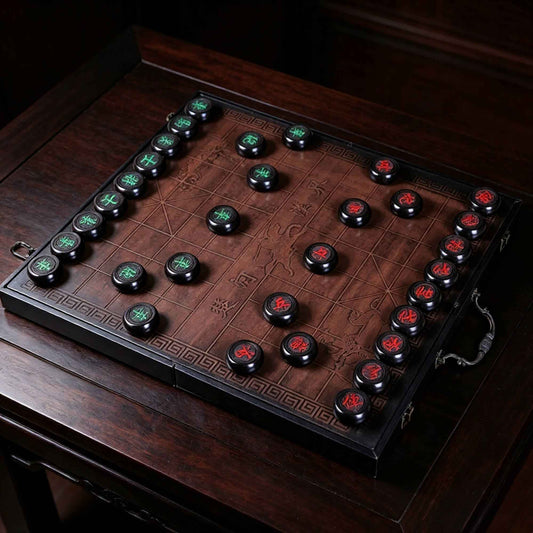
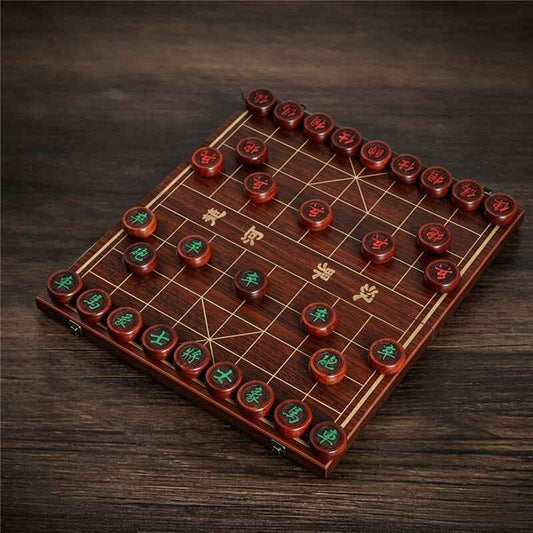
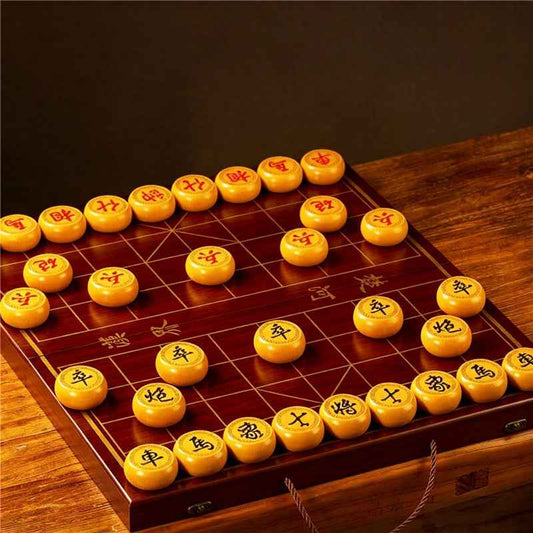
The game of Xiangqi (Chinese chess) is played on a 9 × 10 board with pieces of each side located at the intersections. It consists of a river in the centre, a palace for the general and advisors, and the cannon that also jumps by another piece.
Xiangqi pieces are not allowed to drop, unlike chess, and are captured and removed from the game. Although both games are a part of the same general family of chess-like games, the two are quite different in their features, most notably how their pieces are dropped, the promotion zone, and the piece ownership based on direction.
Is Shogi and Chess Learning possible simultaneously?
Yes, and many players do! Both games involve similar but different skills, but can cause some initial confusion with movements of the pieces.
The most obvious difference is the way that the shogi pawn can move and capture, which is the same way that the chess pawn does, but the shogi pawn can also move diagonally. Typically it is simpler to begin with a simple game and then get used to the other or to practise them in different sessions.
Conclusion: So Which Is Harder, Shogi or Chess?
Shogi is more complicated, but in the initial stages, chess is easier to learn.
Shogi is more complex than Chess, in that it has a higher number of pieces, a higher branching factor, a larger game tree, and a "drop" rule that retains captured pieces for the entire game. These features, along with a multitude of other possibilities, make the calculation very challenging.
Chess is a bit simpler with a less complex material system, but there is an extensive amount of opening and endgame information, and is quite difficult to learn.
So it's hard to answer, as it depends on what you mean by "harder":
- More difficult to master basic rules: It's easier to learn the basic rules of chess.
- In many midgame situations: Shogi is typically difficult to calculate.
- Shogi is more complicated as a game: Based on the widely accepted criteria, Shogi is clearly more complicated.
- Harder to master: It is hard to say which is harder to learn. They both are a lifetime activities.
If you are uncertain which to pick between the two, consider not just difficulty, but the impact that will be made by the choice. Chess could be a player's preferred game, as it offers theory, structure, and long-term strategic planning. Shogi is very rewarding for those who prefer initiative, tactical attacks, drops and decisive games.
If time allows, do both! The tactics, strategy and importance of each move is explored in a different way in each game.