How to Choose a Wooden Chinese Chess Set?
Chinese chess is a game that is played on a 90-box board with 32 pieces, and is referred to as Xiangqi. As far as wooden sets are concerned, look is just one of the factors to consider. The comfort level and longevity of the set is dependent on the piece size, type of wood used, engraving quality and board construction.
Whether you're buying a set for the family, for practice or as a gift, this guide outlines the things to look for before purchasing.
How to Choose a Wooden Chinese Chess Set: Five Key Factors.
First consider the size of pieces and board when you are to purchase a wooden Xiangqi set. After those ones are determined according to playing requirements, contrast the wood, engraving, complete and expense. This will save you from extra expense on a poor quality set that you're not comfortable with.
| Factor | What to Check | Practical Advice |
|---|---|---|
| Piece material | Wood species and construction | Compare the grain, finish and intended use rather than relying on the wood name alone |
| Piece size | Diameter, thickness and weight | Pieces around 35–40 mm in diameter are a useful starting point for many adult players |
| Board configuration | Playing area, grid spacing and construction | Choose a board with enough space around each piece |
| Craftsmanship | Engraving, edges and surface finish | Look for clear characters, smooth edges and consistent workmanship |
| Budget | Materials, construction and accessories | Prioritize playing comfort and build quality over decorative packaging |
Select Piece Material, based on Budget, Feel and Use
Wood will influence the weight, grain, look and upkeep of a piece. Generally, the denser the hardwoods, the more substantial they will be and the lighter the woods the more ease the children will have in handling them, or travel.
When a product listing uses the word 'wooden' it does not necessarily indicate the method of construction. A piece can be constructed of solid wood or glued-up wood or a composite material that has a decorative face. Please read the product description before making price comparisons.
The size and thickness of the pieces are in response to Your Hands and Your Playing Style
Any pieces that are too small to be picked up can be a bit tricky, particularly during fast exchanges. Some pieces are too big to fit on the board and/or to see nearby lines.
The diameter has an impact on how easily the character is read and the spacing of the board, and thickness has an impact on grip and stability. When deciding the size to purchase, consider the type of games that will be played in the set, how long they are likely to last, and who will use the set.
Configure Board: Ensure that the Pieces Fit
The pieces should be able to fit into the intersections and not overcrowd adjacent intersections. The board should also have a flat even playing surface.
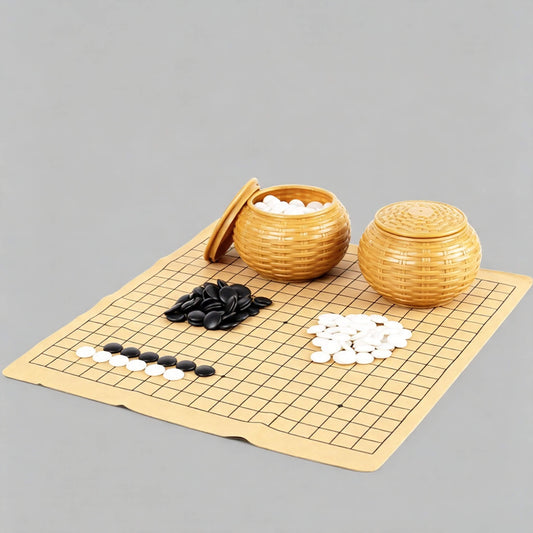
When used at home a folding wooden board would be useful as it can also provide built-in storage. A firm board is ideal for use in the permanent playing area, but a rolled mat will be easier to transport when travelling.
Quality: Don't Skimp on Details
Cautious craftsmanship is denoted by the clear character engraving, smooth edges and even finish. Product images should highlight top, sides and undersides of the product where possible.
When purchasing online, check the closeup photos, and request more pictures if the construction or finish is not clear.
Price: Play at your own price
You don't need a complete set of equipment for home use, that's what you would need at a club.
Households that aren't looking for a high quality set, but want something easy to use with good characters and quality board will find a set in the middle to be a good value. For collectors or gift-givers, premium materials and presentation boxes are acceptable, but this doesn't necessarily make it a better game.

Which is the best material to use to make Xiangqi sets? Woods vs Composites: A comparison
It is not necessarily true that there is a best wood for any Xiangqi player. This depends on your budget as well as the style you want, the amount of weight you want, and the level of workmanship you are looking for.
Other Premium Hardwoods such as Rosewood
The national standard GB/T 18107 has defined a set of timber species, which are called hongmu (红木) in China. It is not enough to just give the name of the game, to specify the exact type of wood used to make a Xiangqi set.
For those appreciating unique grain, heavy body and traditional styling, premium hardwoods might be a good choice. Where a particular wood species is claimed, however, sellers should be able to explain what wood species they use to make the product.
Certain high quality woods found in Xiangqi sets are controlled under CITES. Requirements vary between species, and for different wood products and countries of destination, depending on the rules of the destination country. It is important to check with the seller and the authorities before buying or shipping a set made using a controlled species.
If it is a decorative or collectible set, verify whether it is a rare-wood claim or not prior to paying a premium.
Boxwood, Beech, Jujube, Maple and Oak
There are various combinations of grain, colour and working properties of different woods.
- Boxwood: Highly prized for engraving and for its fine grain. It is a popular choice for those who wish to purchase beautifully crafted wood.
- Beech: Grain typically is fairly straight and the color is light. Can be used with a simple clean style for everyday sets.
- Jujube wood: Frequently a warm reddish-brown colour, and with a distinctive grain. It is often used in Chinese wooden-made crafts or chess.
- Maple: Light in colour and has a subtle grain, it is ideal for more traditional design applications.
- Oak: Is more grainy. It is good for boards and storage boxes, but not as effective as it could be for very fine detail on very small pieces due to its open grain.
These are physical attributes and do not provide a warranty of the product. Other factors that affect a set's performance are workmanship, moisture control and finishing.
Solid Wood, Laminated Wood and Veneered Materials
The presence of a product is as important as the name of the product.
| Construction | What It Means | What to Consider |
|---|---|---|
| Solid wood | Made from natural timber throughout the piece or component | Offers natural grain, but quality and stability depend on the wood and manufacturing process |
| Laminated or glued-up wood | Made by joining multiple wood pieces or layers | Can be suitable for boards and may improve dimensional stability when properly manufactured |
| Wood veneer | A thin layer of decorative wood applied over a substrate | Can provide a wood appearance at a lower cost; check the substrate and edge finishing |
| MDF or other composite materials | Manufactured from wood fibres or other constituent materials | May be suitable for some budget products, but should be described accurately |
Wood may be attractive for commonly-used chess pieces since it runs through the piece. But when it comes to solid wood, quality isn't necessarily better in all areas. A laminated board may be a viable option for boards.

Measurement of Wood Appearance, Weight and Maintenance
| Material | Typical Appearance | General Characteristics | Care Considerations |
|---|---|---|---|
| Rosewood and other premium hardwoods | Often dark or richly coloured, with distinctive grain | May offer a substantial feel and decorative appeal | Keep away from prolonged moisture and direct sunlight |
| Boxwood | Usually pale, with fine grain | Suitable for detailed engraving | Protect from prolonged direct sunlight and excessive humidity changes |
| Jujube | Often reddish-brown, with a tight grain | Traditional appearance for wooden game pieces | Keep clean and store in a stable environment |
| Beech | Generally light, with relatively even grain | Practical for everyday use | Avoid prolonged moisture and rapid environmental changes |
| Maple | Usually light, with subtle grain | Clean, understated appearance | Follow the finish manufacturer's care instructions |
| Oak | Pronounced grain | Often used for boards and storage boxes | Protect the surface finish and avoid prolonged dampness |
| Veneer over MDF | Depends on the veneer or printed surface | Appearance and durability depend on construction quality | Protect exposed edges from moisture and impact |
Weight will vary depending on wood density, thickness of pieces and size of the piece. When weight is a consideration, compare the weight of full sets for similar piece dimensions using the weight information listed as well as the wood name.
Need to make Pieces and Board out of the same wood?
No. Aesthetic match of wood is primarily a preference.
Using lighter board and dark pieces can help the characters become easily recognizable. Most important is that the board be flat, the lines be visible and the pieces move easily within the playing area.
While appearance may be a factor, compare the grain and finish of the set and board as a whole rather than equate the match in material with a good set.
How many Xiangqi parts should you purchase?
The size of the piece is determined by the board, the size of the players' hands and the ease of being able to read the characters.
How Diameter, Thickness and Weight are related
The diameter of a piece will dictate the space it will take up on the board and the size of the characters on the piece. Thickness plays a role in grip and on the playing surface. Each type of material and size will have its own weight.
Lighter pieces are easier to handle when inadvertently brushed, heavier pieces will not move easily. Both are not necessarily optimal for all players.
Small, medium and large pieces
These are not the official size ranges for Xiangqi, but rather are reasonable guidelines to follow when shopping.
| Size Category | Approximate Diameter | Best Suited To | Main Trade-Off |
|---|---|---|---|
| Small / Travel | 20–30 mm | Travel sets and compact boards | Characters may be harder to read |
| Medium / Standard | 32–40 mm | Home play, adults and learners | Requires a board with suitable grid spacing |
| Large | 42–55 mm | Larger playing areas, teaching and display | Needs more board space and storage room |
Please refer to actual board specifications for all measurements. A large piece on a small board could seem cramped, as could a small piece on a large board.
Correlating the size of the pieces with the size and spacing of the board
The board of Xiangqi is divided into squares on the intersections of horizontal and vertical lines and it is played on these intersections with 8 horizontal lines and 9 vertical lines.
It is a good idea to select pieces that are 75-85% the spacing between the lines. For instance, if the spacing of your grid is 45 mm, pieces in the range of 35-38 mm could create a nice balance of pieces, while also leaving a certain amount of space between the items.
This is a guide and not a rule for practice. Also size of the characters and the design of the boards and personal preference can be a factor.
If only the overall dimensions of the board are given, request the dimensions of the play area and/or the distance between the grid lines. Measurements outwards cannot be used to decide if pieces will fit together properly.
Selecting Sizes for Children, Families and Long Sessions
Pieces around 30-35 mm would be easier for children to handle, if the pieces are suitable for their age and the board is of the same size.
35-38 mm pieces are a good place to start for general family play. Adults who like bigger characters or who like to play for longer may like larger pieces, around 40 mm or larger, depending on the dimensions of the board.
Where more than one person is going to be using the same set, select a size that is not too large, but not too small, to ensure good readability, grip and board spacing.
How to Check the Size before Purchase
The word "large" or "standard" are sometimes used in product titles as general descriptions, not specific measurements.
When ordering, please note:
- Measure the thickness and the diameter of the pieces.
- Verify size of board and playing area.
- If it isn't stated, request spacing for the grid.
- Search for pictures of the pieces taken by customers near a hand or other recognizable object.Find photos customers have taken of the pieces next to a familiar object, such as hand.
- Specify if the quoted sizes are for a representative piece or each piece.
Product dimensions are easy to grasp and allow for a clear comparison which makes it easier to order a set that will be the correct size.

How to Judge Wooden Xiangqi Quality Before Buying
A wooden set's quality depends on more than its wood species. Character clarity, edge finishing, surface treatment and consistency all affect the finished product.
Character Engraving and Colour Durability
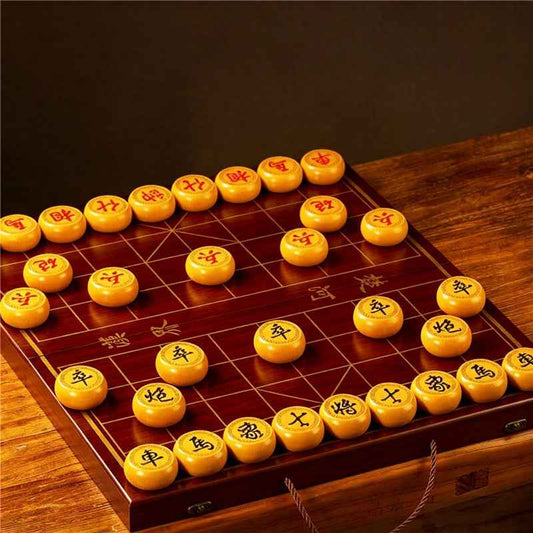
Look for clearly defined characters with clean edges and an even finish. Carved or laser-engraved characters with colour filling can be a good option, but durability also depends on engraving depth, the finish and the quality of the workmanship.
Printed characters can also vary in quality, so inspect close-up photos where available.
Traditional Chinese-character sets use different character forms depending on the set and regional conventions. For example, the characters used for some red and black pieces may differ between simplified, traditional and other established variants. If you prefer a particular style, check the product photos before ordering.
If you are new to Xiangqi and cannot yet read the characters, consider a pictorial set or one that pairs traditional characters with symbols.
Edges, Undersides and Overall Finishing
Check that the edges are smooth and free of splinters. The underside should be reasonably flat so that the pieces sit steadily and do not scratch the board during normal handling.
Some sets have felt pads underneath the pieces. These can help protect certain board finishes, but their presence alone does not establish the overall quality of the set.
If you are buying online, request close-up photos of the sides and undersides when these details are not visible in the listing.
Coating, Odour and Consistency
A well-applied finish should be reasonably even, without obvious sticky patches, peeling or rough areas. The ideal appearance depends on the product: some wooden sets have a natural matte finish, while others use a glossier coating.
Compare pieces from the same set for noticeable differences in size, character placement and finishing quality. Small variations in natural wood colour are normal, but rough edges or inconsistent workmanship may affect the playing experience.
Natural Grain Variation Versus Defects
Natural wood can vary in colour and grain, even within the same set. Uniform colour is not proof of imitation wood, just as visible grain is not proof of solid wood.
To verify the material, check the product specifications and inspect close-up photos of the piece edges and undersides.
Look more carefully if you see cracks running through a character, loose material, rough edges, visible glue lines on a piece advertised as solid wood, or paint that has pooled in the engraving.
Some variation in colour and grain is normal in natural wood. However, noticeable differences in piece dimensions, rough edges or inconsistent engraving may affect the overall playing experience. Check the seller's stated tolerances if precise uniformity matters to you.
How to Check Unclear Material Claims
| Warning Sign | What to Check | What to Do |
|---|---|---|
| The listing only says "wooden" | Exact wood species and construction | Ask the seller to clarify |
| Material claims are inconsistent | Product description and close-up photos | Request confirmation before buying |
| Key dimensions are missing | Piece diameter, thickness and board playing area | Ask for measurements |
| The listing uses vague terms such as "rosewood style" | Whether this refers to colour, appearance or actual wood species | Request the botanical name if species identity matters |
These checks cannot always establish the exact composition of a product, but they can help you compare listings and identify questions worth resolving before purchase.

Choosing a Wooden Xiangqi Board and Storage Box
The board affects playing comfort, portability and storage. Consider where you will use the set and how often you plan to move it.
Folding Wooden Boards Versus Solid Wooden Boards
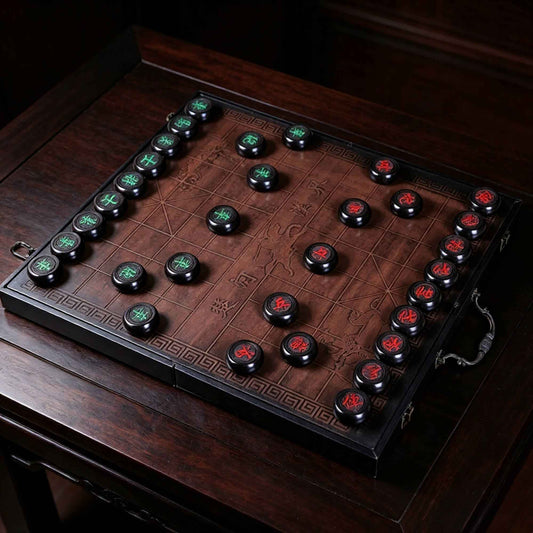
A solid wooden board offers a continuous playing surface and works well for a permanent table or display area. It may be heavier and less convenient to store.
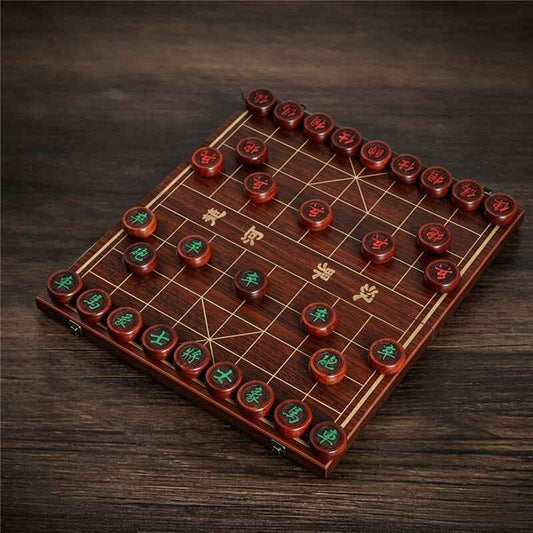
A folding wooden board is easier to put away and may include a compartment for storing the pieces. However, the hinge and joint need to be well made.
When comparing folding boards, check that the two halves sit level when opened and that the joint does not create an uneven playing surface.
Wood, Cloth and Leather Boards: Which Is Best?
| Board Type | Best For | Advantages | Limitations |
|---|---|---|---|
| Solid or folding wooden board | Home play, clubs and gifts | Traditional appearance and a substantial playing surface | Heavier and may require more careful storage |
| Cloth or rolled mat | Travel, schools and group activities | Lightweight, compact and easy to carry | May wrinkle or move during play |
| Leather or PU board | Portable home and travel use | Easy to wipe and convenient to store | Quality varies; some surfaces may crack or peel over time |
Choose according to how you play. A wooden board may suit a permanent playing area, while a rolled mat is often more practical when portability matters most.
Board Size, Construction and Portability
Board stability depends on more than thickness. Look for a flat playing surface, well-aligned joints and sound construction.
If you choose a folding board, check that the two halves sit level when opened and that the hinge does not create an uneven playing surface.
For frequent travel, consider the folded dimensions and total weight of the complete set rather than looking only at the board material.
Boxes, Bags and Other Storage Options
A storage box helps keep pieces together and reduces the chance of losing them. A cloth bag is lighter and often less expensive, but provides less protection from impact.
Some folding boards include an integrated storage compartment. This can be convenient if you open and close the set frequently.
Before buying, check whether the storage box or bag is included in the listed price and whether it accommodates all 32 pieces.
What Should a Complete Xiangqi Set Include?
A standard Xiangqi set contains 32 pieces, with 16 pieces per side. Each side has one general, two advisors, two elephants, two horses, two chariots, two cannons and five soldiers.
Before ordering, confirm that the listing includes:
- All 32 pieces.
- The board, if the product is advertised as a complete set.
- A storage box or bag, if included in the description.
- Any instruction sheet or accessories shown in the product listing.
- Information about replacement pieces, if these are important to you.
Check the product details carefully, as some listings sell pieces and boards separately.

Which Wooden Chinese Chess Set Fits Your Needs?
Different players have different priorities. Use the following recommendations as starting points, then compare them with the actual product specifications.
Everyday Home Play
For a household that plays regularly, consider pieces around 35–40 mm in diameter and a board that stores easily. Beech, boxwood and jujube are all worth considering, depending on your preferred appearance and budget.
A folding board with an integrated storage compartment can be convenient for keeping the set together between games.
Children Learning Xiangqi
Lighter pieces around 30–35 mm may be easier for some children to handle, provided the board is sized appropriately.
Check the product's age guidance, finish information and applicable safety documentation. If the set is marketed as a children's toy, look for relevant safety testing or compliance information rather than relying only on a general statement that the finish is non-toxic.
In the United States, ASTM F963 requirements may apply to children's toys, while relevant European toy safety requirements may apply in Europe. The applicable requirements depend on the product and market.
Small pieces can present a choking hazard for children under three. Follow age warnings and keep unsuitable sets out of reach.
A pictorial set can also help beginners become familiar with the game before learning all the Chinese characters.
Gifts for Older Players and Friends
For someone who has played Xiangqi for years, larger characters and a comfortable piece size may be especially important. Pieces around 40 mm or more are worth considering if the board has enough space.
For someone new to the game, a well-finished mid-range set with convenient storage may be a practical gift.
Packaging can improve presentation, but it should not be the main reason to choose a set. Prioritize the pieces, board and construction first.
Tea Rooms, Clubs and Training Classes
Venues that use multiple sets should prioritize durability, easy cleaning and consistency between products.
When ordering in bulk, request a sample first. Check the piece dimensions, character legibility, surface finish and board construction before committing to a larger order.
If replacement pieces may be needed, ask whether the seller can supply matching pieces from the same design or production range.
Display and Collecting
Collectors may place greater value on wood species, grain, finishing techniques and the maker's reputation.
If you are buying a premium set, ask for the specific wood name and supporting documentation where appropriate. If the seller describes a product as antique or made from rare wood, request evidence supporting that claim.
For regulated wood species, verify any applicable trade requirements before placing an international order.
Quick Comparison by Use Case
| Use Case | Suggested Piece Diameter | Material to Consider | Board Type |
|---|---|---|---|
| Home play | 35–40 mm | Beech, boxwood or jujube | Folding wooden board |
| Children | Around 30–35 mm, if age-appropriate | Lightweight wood with a suitable finish | Appropriately sized board or mat |
| Older players | Around 40 mm or larger, if compatible | Wood with clearly defined characters | Solid or folding board |
| Clubs and classes | Around 38–42 mm, depending on the board | Durable, consistently finished pieces | Easy-to-clean board |
| Collecting and display | Often 40 mm or larger | Documented premium hardwood, if desired | Solid board or presentation set |
These are general shopping suggestions, not formal size standards. Confirm the board dimensions and product specifications before deciding.

How Much Should a Wooden Chinese Chess Set Cost?
The price of a wooden Xiangqi set depends on its materials, dimensions, construction, finishing and accessories. The ranges below are broad budgeting guides rather than verified market averages.
Entry-Level Sets: Basic Features for Casual Play
Indicative budget: Under US$60
At this level, you may find simple sets made with common woods or other disclosed materials, basic finishes and folding boards.
Focus on clear dimensions, comfortable pieces and a board that fits them properly. A lower price does not automatically mean poor quality, but check the material description and construction carefully.
Mid-Range Sets: A Balance of Materials and Craftsmanship
Indicative budget: US$60–199
Depending on the seller and market, this range may include better-finished pieces, more carefully executed engraving, sturdier boards and more convenient storage.
For many buyers, this is a useful range to explore because it offers room to compare construction and presentation without committing to a collectible-grade set.
Premium Sets: Materials, Finishing and Presentation
Indicative budget: US$199 and above
Premium sets may cost more because of the wood species, detailed finishing, board construction and presentation box. Sets made from documented premium hardwoods can cost considerably more.
These features may matter to collectors and gift buyers, but they do not necessarily make a set more comfortable for everyday play.
Comparing Budget Tiers
| Budget Tier | Indicative Price | What to Compare | Best Suited To |
|---|---|---|---|
| Entry | Under US$60 | Basic construction, dimensions and finish | Beginners and casual players |
| Mid-range | US$60–199 | Material claims, engraving, board quality and storage | Regular players and gifts |
| Premium | US$199 and above | Wood identification, workmanship and presentation | Collectors and special gifts |
Actual prices vary by region, retailer, shipping costs and product specifications. Compare current listings in your target market before treating these ranges as a purchasing benchmark.
Which Features Justify a Higher Price?
Some features can justify paying more, depending on your priorities:
- Clearly identified wood species.
- Carefully finished surfaces and edges.
- Clear, consistent character engraving.
- A flat, well-constructed board.
- Convenient storage and useful accessories.
- Supporting documentation for material claims when relevant.
Be cautious of vague phrases such as "ancient craftsmanship" or "rare wood" when the listing provides no supporting information.
A higher price is easier to evaluate when the seller explains exactly what makes the product different.
How to Compare Products When Shopping Online
When comparing two sets, check the same specifications for each product:
- Piece diameter and thickness.
- Board dimensions and grid spacing.
- Wood species and construction.
- Character engraving and surface finish.
- Included accessories and storage.
- Shipping costs and return policy.
Customer photos can help you assess the appearance of a set in ordinary lighting. Reviews that describe the condition of the pieces after extended use may also be useful, although individual experiences do not guarantee the same results for every buyer.
If a key specification is missing, ask the seller before placing the order.
Wooden Chinese Chess FAQ
What Is the Difference Between Solid Wood and Other Wooden Xiangqi Sets?
Solid wood pieces are made from natural timber throughout the piece. Their colour and grain may vary naturally.
The term "wooden" alone does not tell you whether a product is solid wood, laminated wood, veneered material or a composite. Check the construction details rather than relying on the product title.
Solid wood may appeal to buyers who value natural grain, while a well-made laminated panel can be a practical option for a board.
Can Wooden Xiangqi Pieces Crack or Warp?
Yes. Wood responds to changes in temperature and humidity, and unsuitable storage conditions can contribute to cracking or warping.
Keep the set away from prolonged moisture, direct sunlight and strong heat sources. Store it in a reasonably stable indoor environment and follow any care instructions provided by the manufacturer.
A surface coating may slow moisture exchange, but it does not make wood completely immune to environmental changes.
What Should I Do If the Pieces Have a Strong Smell?
A mild natural wood scent may fade with time, but a strong or irritating chemical odour should not be ignored.
Stop using the set if the smell causes irritation, keep it in a well-ventilated area away from children, and contact the seller for information about the finish or adhesive used.
Avoid applying cleaners or oils unless the manufacturer confirms they are suitable for the product's finish.
How Should I Clean and Store Wooden Xiangqi?
For most finished wooden pieces, start with a soft, dry cloth. If the manufacturer permits a slightly damp cloth, dry the pieces immediately afterward.
Do not soak the pieces or use harsh solvents. For unfinished wood, follow the manufacturer's care instructions before applying any oil or wax. For lacquered or otherwise coated pieces, a soft, dry cloth is usually the safest starting point.
Store the set in a dry, stable indoor environment. If the board has a delicate surface, use suitable protective material to prevent the pieces from scratching it during storage.
What Should a First-Time Buyer Prioritize?
Start with a comfortable piece size and a board with suitable grid spacing. Then compare the wood or construction, character legibility, finish and storage options.
Do not assume that the most expensive wood will provide the best playing experience. If you cannot yet read Chinese characters, consider a pictorial set or one that pairs characters with symbols.
How Can I Avoid Receiving a Set That Does Not Match the Listing?
Look for listings that provide the wood or construction details, piece dimensions, board dimensions and clear product photos.
If any important specification is missing, ask the seller for confirmation before ordering. Review the return policy and keep the packaging until you have checked the delivered product against the listing.
For premium hardwood sets, verify the claimed wood species and any applicable trade requirements before purchasing.
Conclusion
For most players, comfortable piece sizes, clear characters and a stable board matter more than an expensive wood name. Compare the actual dimensions, construction and finish before buying, and choose a set that suits your playing habits and budget.
If you are considering premium hardwoods, verify the species and check any applicable trade requirements before ordering.