Is Go(weiqi) Hard to Learn? The Truth About Go’s Difficulty for Beginners
Go has a reputation. Mention it to most people, and you will hear something along the lines of “isn’t that the game even computers struggled to beat humans at?” or “that looks impossibly complicated.” With a 19×19 board, 361 intersections, and a history stretching back over 2,500 years, Go carries an aura of intellectual exclusivity that can intimidate even the most curious beginners.
But here is the truth that few people tell you: Go’s rules can be explained in a few minutes. The difficulty lies not in learning how to play, but in learning how to play well. And that is a very different statement.
This article cuts through the myths surrounding Go’s difficulty. You will learn what actually makes the game challenging, why the beginner stage is far more accessible than you think, and whether you—as an adult, a busy professional, or someone who has never touched a board game—can still learn and enjoy this ancient masterpiece.

Why Do So Many People Think Go Is Difficult?
The intimidation around Go is not entirely unfounded, but much of it stems from misconceptions about what the game demands at different stages of learning.
The 19×19 Board Looks Overwhelming to Beginners
Compared to chess’s 8×8 board or checkers’s smaller grid, Go’s standard 19×19 playing surface looks like a vast, empty ocean. With 361 intersections where stones can be placed, a beginner staring at the board for the first time often has no idea where to even start.
This visual complexity creates a psychological barrier. The sheer number of stones and the open space make the game feel like it requires a special kind of intelligence—something innate, something you either have or you do not.
What experienced players know: The 19×19 board is not where beginners should start. Professionals and educators universally recommend that new players learn on a 9×9 board, which has only 81 intersections. On this smaller board, the game becomes conceptually manageable. You can see how territory forms, understand basic tactics, and complete a game in minutes rather than hours. After a few games on 9×9, you graduate to 13×13, and only then do you move to the full 19×19 board.
The Number of Possible Moves Feels Paralyzing
Here is a number that gets thrown around a lot: Go has more possible positions than there are atoms in the observable universe. The total number of possible Go games is estimated at around 10^808. By comparison, chess has roughly 10^201 possible games.
For a beginner, this statistic is paralyzing. If there are that many possibilities, how can anyone possibly make a good move?
What this statistic actually means: The number of possible positions is largely irrelevant to a beginner. You do not need to calculate 50 moves ahead to play your first game. You do not need to understand every possible variation. You need to know four things: how to place a stone, what a “liberty” is, how to capture, and how to count territory. That is it.
The astronomical numbers describe the game’s theoretical depth, not its practical entry barrier. Think of it like language: the number of possible sentences in English is infinite, but you can learn to order coffee on your first day.
Complex Games Lead Beginners to Believe Talent Is Required
When people see skilled Go players making subtle, whole‑board judgments, they assume that these players possess some rare gift. The game looks like abstract art—beautiful, but inaccessible to anyone without a special mind.
This perception is reinforced by Go’s history. For decades, Go was considered the ultimate test of artificial intelligence. Computers beat the world chess champion in 1997, but it took until 2016—nearly 20 years later—for AlphaGo to defeat a top professional Go player. If the world’s best AI researchers struggled for so long, surely the game must be impossibly hard for ordinary humans.
The reality: The AI difficulty curve is not the human learning curve. Computers struggled with Go because the game requires pattern recognition and intuition—things humans are naturally good at and computers historically were not. For a human beginner, learning the basics of Go is easier than learning the basics of chess, because Go has fewer rules and no complex piece movements to memorize.

Where Does Go’s Real Difficulty Lie?
If the rules are simple and the beginner stage is manageable, what actually makes Go difficult? The answer lies in three core challenges that emerge only after you start playing seriously.
Challenge 1: Understanding “Whole‑Board Thinking” Instead of Just Local Tactics
In chess, the goal is clear: checkmate the king. Every move serves that immediate, tangible objective. In Go, the goal is to control more territory than your opponent—but territory is not something you capture in a single dramatic move. It is something you build, piece by piece, across the entire board.
The beginner’s trap: New players focus obsessively on capturing stones. It feels satisfying. It is concrete. You can see the stones disappear from the board. But capturing stones is a means, not an end. Many beginners lose games despite capturing more stones, because they neglected the bigger picture.
What skilled players do: Strong players evaluate the value of every move across the entire board. A move in one corner affects the value of stones in the opposite corner. A stone that looks “dead” might later become useful. A capture that seems obvious might actually be a mistake because it wastes a move that could have been spent on something more valuable elsewhere.
This is the first real difficulty of Go: learning to think globally rather than locally. It is not about memorizing sequences. It is about developing a sense of priority—knowing which part of the board matters most at any given moment.
Challenge 2: Judging the Value of Individual Stones
In chess, every piece has a clear point value. A queen is worth 9 points, a rook is worth 5, a pawn is worth 1. You know exactly what you are giving up and what you are gaining.
In Go, stones have no inherent value. A single stone can be worthless or priceless, depending entirely on context. This creates a paradox that beginners find deeply confusing: why would a player ever willingly give up stones?
The concept of sacrifice and trade‑off in Go: Skilled players frequently allow their stones to be captured—or even deliberately place stones knowing they will be captured—because those stones served a strategic purpose. They might have created influence in another part of the board, forced the opponent to spend moves capturing them, or simply been less valuable than the alternative moves available.
This is known in Go as the art of sacrifice and trade‑off—the skill of choosing what to keep and what to abandon. It is a deeply counterintuitive skill for beginners, who naturally want to save every stone. Learning to let go is one of the most important steps in progressing from beginner to intermediate player.
Challenge 3: Making Decisions in the Face of Uncertainty
Chess has clear, tactical objectives. Attack the king. Defend your pieces. There is usually a “best” move in any given position, and with enough calculation, you can find it.
Go rarely offers a single correct answer. In many positions, there are five or ten reasonable moves, each leading to a completely different game. There is no algorithm for determining which one is “right” because the “right” move depends on your overall strategy, your opponent’s style, and the ever‑shifting balance of the board.
What this means for learning: Progress in Go does not feel linear. You cannot simply memorize openings and tactics the way you can in chess. Improvement comes in waves rather than steps. You play a game, lose, and are not always sure why you lost. There was no single mistake. You just made slightly worse decisions over the course of 200 moves.
This uncertainty is what makes Go so intellectually rewarding—but it is also what makes it frustrating for beginners who expect clear feedback on their mistakes.

Is Go to Learn a Hard Beginning Language? The Rules Are Very Easy.
Let's clear up some of the myths from the reality. There are two very different answers to the question, “how hard is Go?” when interpreted according to the different meanings of “learn.”
Just a few concepts are all you need to get started playing.
All the basic Go rules can be taught in less than 10 minutes. The following is what you need to know:
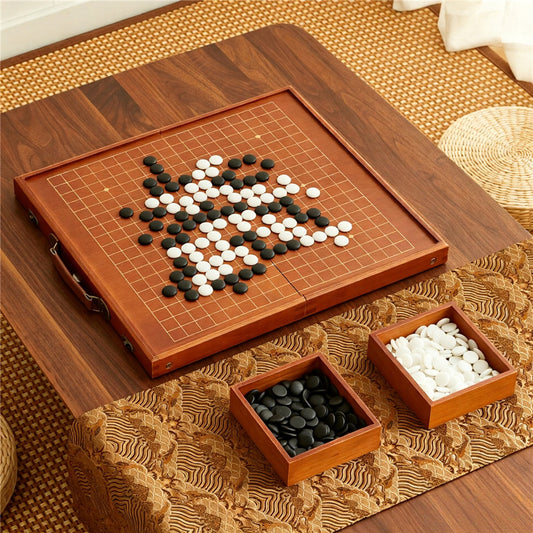
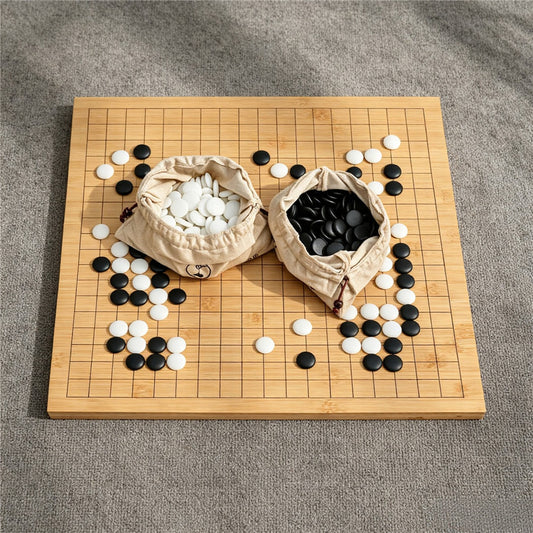
Board and stones: Go is played on a set of lines (usually 19×19 although the grid size for beginners is 9×9). The players alternately drop stones onto the intersections (not squares). Black moves first.
Capturing and liberties: Each stone or cluster of stones has some spaces around it (called liberties) that are empty. If all liberties are blocked by opponent's stones, the stone (or group) is taken off the board. Stone that has one liberty remaining is called atari (meaning "at the door") as it will soon be captured.
Living and dead groups: A group of stones is “alive” if it contains two eyes (separate empty areas inside the group that the opponent can't fill without killing him/herself). Eventually, groups with less than two eyes are able to be captured.
Territory and scoring: The objective is to get around more intersections without any cars than the other team. After the game you add up all the points that are empty inside the space that you made with your surrounded points, and points you collect for the stones. The winner is the player who has more points.
That is it. The four are all that are necessary to form a full game of Go. No openings, no tactics and no advanced strategies are required. All you need to know are the rules.
Why is it so difficult to make progress when learning the rules?
Go's reputation of being difficult comes from the fact that while the game is known, it is not a very good one.
Intermediate stage: You are familiar with how to place stones, capture and count territory. It is possible to complete a game. You know the fundamentals of how it works.
Elementary stage: Unable to make any longer obvious errors. Does not play moves that trap the stones in play. Simple patterns are starting to emerge.
Intermediate State: You can develop a plan. Understands the significance of corners and sides. Have a general idea of attack/defense timing.
Advanced stage: You have an understanding of dynamics on the whole board. Trade‑offs can be assessed. You view the board as a whole network of battles instead of individual battles.
There is a distinct learning that needs to be taken place at each stage. The rules are: memorization. There are intermediate steps that involve pattern recognition. Advanced stages can only be dealt with by intuition and judgment. It is for this reason that Go is an endless game: Every time you learn something about a level of understanding, another level appears below you.

How long will it normally take an ordinary person to learn Go?
The period of time will be based on the definition of “learn.” Here is a possible division that is realistic.
A Few Days: Basic Rules to Learn.
In a matter of days of dedicated work – or even one afternoon with a patient teacher – you can:
- Have knowledge of the rules of the 9×9 board and placement of stones.
- Understand the meaning of liberties and how they are applied in the game of capture.
- Know how to identify atari in a group.
- Finish a "countable" game.
As of now you're not playing well, but you're playing legally. You know the game pretty well and enjoy it.
A few months: Developing early thinking about going.
By practicing for several months (about 3 to 6 months of regular practice) one can acquire basic Go thought. This includes:
- Knowing opening fundamentals (corners then sides then center).
- Recognizing basic life‑and‑death patterns.
- To be familiar with the characteristics of common shapes.
- Implementing simple attacks and/or defense.
Children who have been taking the structured lessons will usually have reached this level of performance in about 10 lessons, and be able to play 19×19 games comfortably in about 1 year. Strong analytical skills may be beneficial for adults to make faster progress in early stages.
A number of years: Moving to Higher Levels.
Amateur dan level (expert in the advanced amateur section) is usually attained in 2 to 3 years of consistent practice with approximately 1 hour of practice a day by children. The time line can be longer for adults who don't have much time.
Here you're not merely playing moves, you're thinking about the game in a completely different manner. You know what it means to do a whole board assessment, make a strategic decision and deal with the multi-front battles.
The bottom line: Do not rush, go is a marathon and not a sprint. However, the reputation of the early miles is not as bad as it may seem.

Is It Too Late for Adults to Learn Go?
This is one of the most common questions prospective adult learners ask. The short answer is no. The longer answer requires understanding both the advantages and challenges adults face.
The Adult Advantage: Better Understanding, Clearer Goals
Adults have several significant advantages over children when learning Go.
Stronger conceptual understanding: Adults grasp abstract concepts more quickly. The idea of “territory” as an abstract space rather than a physical possession makes sense to an adult in a way that requires extensive teaching for a young child.
Better strategic thinking: Adults have more life experience with trade‑offs, long‑term planning, and resource allocation. These skills transfer directly to Go.
Clearer motivation: Adults choose to learn Go because they want to. They are not being pushed by parents. This intrinsic motivation leads to more focused, efficient learning.
Transferable skills: Adults can draw analogies from other domains they already understand—investing, business strategy, even cooking—to grasp Go concepts more quickly.
The Adult Challenge: Time, Frustration, and Structure
Despite these advantages, adults face real obstacles.
Limited time: Adults have jobs, families, and responsibilities. Children in structured programs often practice daily for an hour or more. Many adults struggle to find even 30 minutes of consistent practice time.
Frustration tolerance: Adults are often harder on themselves than children are. Losing to a 10‑year‑old can be ego‑crushing. Many adults quit because they feel they “should” be better than they are.
Lack of structure: Children typically learn through classes with clear progression paths. Adults often try to teach themselves through scattered online resources, which leads to gaps in understanding and slower progress.
The good news: None of these obstacles are insurmountable. Adults who commit to regular practice, accept that losing is part of learning, and find structured learning resources can absolutely reach strong amateur levels. There are documented cases of adults starting in their 40s and reaching dan level. The key is persistence, not age.
Is Go Really Harder Than Chess and Other Board Games?
This is a common comparison, and the answer depends on what metric you are using.
Go vs. Chinese Chess: What Makes Go Harder to Start?
Chinese chess has more complex rules than Go. Each piece moves differently—horses jump, cannons require a screen, elephants are confined to their side of the river. Learning all these movements takes time.
Why Go feels harder for beginners: Despite its simpler rules, Go’s open board offers no obvious first move. In Chinese chess, you place pieces in established positions. In Go, the board starts empty. A beginner can feel completely lost about where to even begin.
The trade‑off: Chinese chess is harder to learn initially but easier to play passably. Go is easier to learn initially but harder to play well.
Go vs. International Chess: Why Go Requires a Different Kind of Thinking
International chess has a clear, concrete objective: checkmate the king. Every move serves that goal. There are defined openings, known tactical patterns, and a clear hierarchy of piece values.
Go has none of these guideposts. There is no single target. There is no piece value system. There is rarely a single “best” move. This makes chess feel more intuitive to many beginners—you always know what you are trying to achieve—while Go feels abstract and confusing.
One expert framing: “Above all, chess is principally a game of tactics, Go of strategy.” Chess rewards calculation and pattern recognition. Go rewards whole‑board evaluation, trade‑off analysis, and long‑term planning. Neither is inherently “harder”—they are hard in different ways.
The Data on Complexity
If you measure difficulty by the sheer number of possible positions, Go is dramatically more complex:
| Game | Board Size | Possible Positions |
|---|---|---|
| Go | 19×19 (361 points) | ~10^808 |
| International Chess | 8×8 (64 squares) | ~10^201 |
| Chinese Chess | 9×10 (90 points) | ~10^200 |
But these numbers measure theoretical complexity, not practical learning difficulty. For a beginner, the question is not “how many positions are possible?” but “how quickly can I understand what I am supposed to do?” On that metric, Go is actually more accessible than chess, because you only need to learn one type of piece and one type of movement.

What are the ways to make learning EASIER?
Go is not something that is easy, but with a proper approach it is possible. Here are some tips to reduce the barrier.
Be sure not to start with Advanced Techniques.
The worst thing first-time investors do is assimilate their actions to those of pros. They play some of the best games, read books on advanced openings, and then can't do it when it comes to a match of their own.
The correct sequence:
- Read, understand, and follow the basic rules.
- Get to know some simple capturing techniques.
- Develop simple shapes and patterns.
- Understand opening principles (corners first).
- Develop strategic awareness step-by-step.
Each step adds on to the last. It is important to take every step in order so that they are not confused and frustrated.
Develop “Board Sense” with easy, frequent practice.
As a beginner, you'll do best to get better by playing a lot of simple games and solving the simplest problems.
Do basic life‑and‑death problems: These puzzles (called tsumego) train your eye to see patterns. Do the most basic ones first. The idea isn't to get them solved right away, the idea is to train the brain to see shapes automatically.
Play on smaller boards: 9×9 games are quick games (10-15 minutes) and you will have to play fundamentals. Play many of them. There's always a lesson to be learned in each game.
Analyze errors: Consider after each game where you have lost stones or where you have not been able to secure territory. Do not simply "go through the motions," recognize what you are doing wrong. How to develop intuition.
Discover a Learning Method that Works for You!
Each one of us has a unique learning style. Discover the way that fits YOU!
Step by step Go courses: There are online courses that provide step by step Go courses. For adults that are looking for a clear path forward, these are great choices.
Online Go platforms: Web sites, such as OGS, provide a place to play Go with people who play at comparable levels. The best way of regular practice is to take part in the game.
Analysis of games using AI: AI can analyze your games and identify errors. It is a personal trainer but use sparingly as a beginner. Understand the reasoning behind the AI's recommendations, rather than blindly following them.
Playing with a friend: Nothing can beat playing the game of Go with a friend at a similar level. Together you learn, together you laugh about your mistakes and you motivate each other.
But, is Go Right for You?
Go is not a right for everybody and that's fine. However, the difficulties that are associated with getting into the market are not that high as they are reputed to be.
If you:You're a great fit for Go if:
- Like to play strategy games and think strategically.
- Looking to enhance logical and decision making abilities.
- Similar to challenges that are based on long-term thinking, rather than short-term tactics.
- Will be willing to lose a lot of games as you are learning (this is the way everyone learns).
You Do Not Need:
It's not about intelligence itself, it's about pattern recognition, patience and strategy, that's what High IQ: Go rewards. There are lots of very smart people that are awful at Go. Many common folk make great players.
Background in games: It is not necessary to have experience of playing chess or other board games. It's a world of its own in Go.
Begin as a child: Adults are more likely than children to develop their learning of Go differently, but they can certainly learn Go well as children. The consistency of practice and mindset are important.
Final verdict: Always begin, never stop, Go is Hard to Master.
OK, back to the original question: Is Go really that difficult?
Learning rules: Not a big deal. Ten minutes (or less)
Learning to play: Needing practice as per learning any new skill. With regular playing for a couple of months you will go from the absolute beginner to a competent amateur.
Playing well: Hard.The difficulty of learning to play well is hard. Requires years of study, thousands of games and constant introspection. This is the reason that Go's reputation is earned.
Problem isn't difficult – the actual barrier is: Not intelligence. Not age. The real obstacle is NOT to start. People still don't take the first plunge because Go is an extremely difficult game. They examine the 19×19 board and listen about the billions of different positions, and conclude that it is too much for them.
However, the 19×19 board is not the one to begin with. The billions of positions are not the ones you are thinking of! Just one is important: the first stone.
Place it. See what happens. Lose a few games. Learn a few things. Lose some more. Slowly the chaos sorts itself out to patterns. The blank board takes on the shape of possibilities. But at some point you realize that it's not about being smart enough to play Go. It's an exercise in curiosity, in wanting to continue playing.
It's not that the game is particularly difficult, it's just that it's so rewarding! That reward can be had by anyone who will put the first stone.