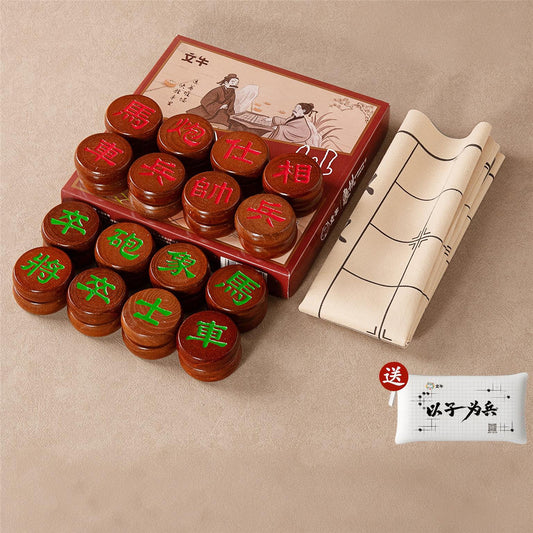
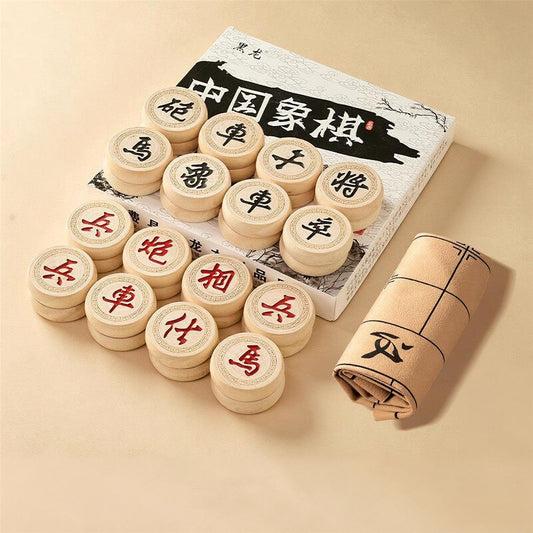
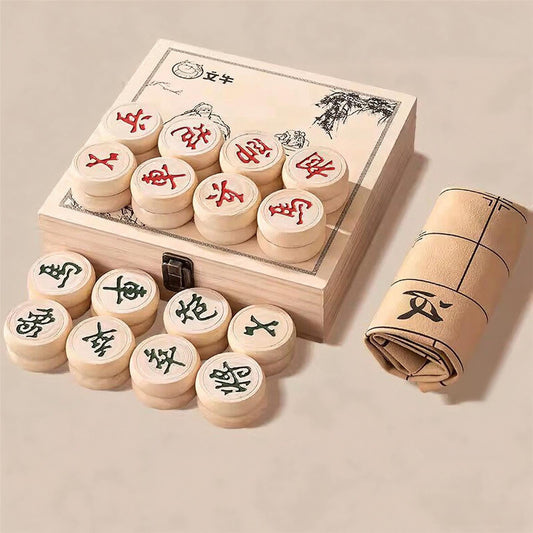
Is Chinese Chess Harder Than International Chess? A Data-Backed Comparison
Having interacted with both boards you will have heard strong arguments on both sides of this debate. Western chess enthusiasts argue that their game requires more calculations, whereas Chinese Chess (Xiangqi) advocates that it is more complex in terms of piece positioning and rules. The truth is, it's a relative term, because mathematical difficulty, learning curve, and competitive proficiency all have different answers. So let's take apart the actual numbers and real-world experience of each angle and make our own educated guess, rather than going with the internet chatter.

The Short Answer
In terms of mathematical complexity, Xiangqi is more complex than international chess. It has a state space complexity of about 10^48 (the number of legal board states) which is approximately 10^46 for chess. It is estimated that the number of possible sequences of moves in the game-tree for Xiangqi is approximately 10^150 and the number of possible moves in the game-tree for chess is approximately 10^123. The average branching factor, or the number of legal moves a player has on an average move, is slightly higher with Xiangqi (about 38) than with chess (about 35). Based on well-known game theoretic analysis, they are the same as the metrics employed to compare the depth of search of computer games engines.
With human learning and competitive play though, the gap is dramatically reduced from pure math. After about a month of regular practice, most students achieve basic standard in either game, while a serious study of either sport can eventually lead to a strong competitive standard in about five years. In the end, Xiangqi is definitely a winner in terms of combinatorics, but when it comes to time it takes a human to master a game, there's no difference between chess and Xiangqi.

Comparing the Two Games Side by Side
| Dimension | Chinese Chess (Xiangqi) | International Chess |
|---|---|---|
| Board structure | 9×10 grid, pieces placed on intersections | 8×8 grid, pieces placed inside squares |
| State-space complexity | ≈10^48 | ≈10^46 |
| Game-tree complexity | ≈10^150 | ≈10^123 |
| Average branching factor | ≈38 legal moves per turn | ≈35 legal moves per turn |
| Piece density | Lower density due to larger board and river/palace zones | Higher density, pieces packed into a smaller 64-square space |
| Core movement logic | Highly constrained (blocked horse legs, elephant "eye" restrictions, generals can't face each other, cannon needs a screen to capture) | More open and flexible (queen moves freely in all directions, pawns can promote, king can join late-game attacks) |
| Promotion/upgrade mechanics | Pawns crossing the river gain forward-diagonal movement options, creating comeback chances | Pawn promotion to any piece (usually a queen) on reaching the back rank |
| Time to reach beginner competence | ≈30 days | ≈30 days |
| Time to reach professional-level mastery | ≈5 years | ≈5 years |
For there are different kinds of difficulty that the Rules themselves create.
The challenge of xiangqi is being constrained. Almost all of the pieces have a structural restriction: the horse can be blocked by one of the other pieces next to it (its "hobbled leg"), the elephant may not move if the diagonal piece is taken by another piece, the two generals may never be diagonally placed on a line of free pieces, and the cannon is only allowed to be blocked by a single piece when jumping over it. With these restrictions, it is extremely difficult to determine a few moves in advance in Xiangqi and it is one of the reasons why the opening theory of Xiangqi ("dingshi") has developed to be such a huge collection of known combinations during centuries of competitive play in China.
International chess, on the other hand, is more free than constraining. The queen can dominate any open line in any of her 8 directions and there is no "screen" requirement for the queen or "blocked-leg" rule for the horse. What chess replaces with structural constraint is tactical density: what is the best time to castle, how to promote a pawn, and how to balance king safety and piece activity are just a few of the ways this type of complexity is different, emphasizing positional judgment and long-range planning over constraint-tracking. Many good players state that Xiangqi is harder because it is “tactical and immediate”, as threats have a tendency to become reality more quickly on its more open board structure, as opposed to “positional and abstract,” as many claim to see in chess.

The depth of calculation and the practical aspect of decision making and problem solving.
Chess is generally considered to be a game with much more forward calculation per move in over-the-board games, because there are no built-in movement restrictions, so more branches need to be explored per ply. In the game of chess, it takes just one missed tactical move, such as a hanging piece or an unprotected back rank, to lose a game and that is why there is a strong emphasis on opening preparation and calculated traps in competitive games.
In the mid- and late-game, Xiangqi's decision making process also favours the element of intuition and ambush play. Pieces can only interact in limited ways, and well-planned multi-move setups are common, where the player sets an opponent in a "screen" or "canon," and then they miss a line or way to engage them. The possibility to acquire new movement possibilities after crossing the river also introduces an inherent comeback feature in chess, which isn't really found in standard chess, as chess' pawn promotion is a lot less frequent and typically occurring only in end games that have already been decided.
On the AI/engine development end, both games offer similar challenges. While computer game researchers have noted that the number of possible states is different for modern Xiangqi and for chess, the amount of computation it takes to develop a powerful engine for either game is thought to be approximately the same, using heuristic search and alpha-beta style pruning.

This is an educational project that aims to enhance understanding of the learning curve and cultural familiarity.
The cultural aspect is a component of the game that is frequently overlooked in the "which is harder" discussion, and not just the complexity of the rules. In areas where the rules of Xiangqi are part of everyday life, its movement rules can be grasped almost instinctively: The river boundary and the nine-point palace are so much a part of daily life that they are reinforced the longer a player plays, and are second nature for those who have grown up with the game. In contrast, people who have never played Xiangqi can sometimes take some time to get used to the rules governing the movement of the pieces, as there isn't a single unifying rule to chess's "each piece type just moves in its own pattern" that helps them internalize them.
International chess, which has a more standardized set of rules worldwide and a plethora of English-language instructional books, tutorials, etc., can be more sometimes easier to play for first time players outside of Asia, but can be just as devastating when a player reaches intermediate level play. To cut a long story short, when the difficulty level is low, it's not necessarily the attribute of the rules, but the game you were exposed to first.
Well, Who's the Harder One?
Mathematically, if you're measuring by size of the state space, size of the game tree, branching factor, etc., then it's slightly more in favor of Xiangqi: the state space is larger than that of Go, and the game tree is larger, and the branching factor is marginally lower. Comparing it on the basis of human mastery time, the two games are more or less equal: Each takes about a month to master the basics, and about 5 years to reach a decent competitive level. If you consider the kind of mental exercise involved, you'll find chess to be more demanding of long-range positional planning and tactical foresight, and Xiangqi will be more demanding of constraint management and ambush-style strategic thinking.
There is no "right" or "wrong" answer, as they are measuring different things. Since it is never the question of how hard a game is, but how hard a game is for you, the best advice for any player considering playing a game is to choose the one they find most enjoyable: international chess is an open game, with players frequently calculating a variety of moves, or is it Xiangqi, with the game playing in a constrained manner and moving at a much faster pace?