How to Set Up Chinese Chess (Xiangqi): A Complete Guide for Beginners
Many people have seen a Chinese chess box and seen the thirty-two round wooden discs with their ancient script and felt overwhelmed.If you've ever viewed an ancient script covered chess disk box and felt overwhelmed by the thirty two round wooden disks covered in ancient script, you're not alone. Being a new player, the first challenge that you need to overcome is not the tactics – it's just knowing which piece goes where on the board! The first layout is essential for each game and many people get the initial layout wrong by either putting the cannon in the spot of the pawn, or put the elephant and the advisor in the wrong spots. In this guide, I will guide you through the exact set-up and explain why each of the pieces goes in this position and the common errors that even experienced players make when they first start. At the end, you can confidently and precisely set up a standard Xiangqi board in less than a minute.

Basic information about the Battlefield and the Pieces.
Before putting the first piece into the game, read the board to get a feel for the game. It is made up of 9 vertical lines and 10 horizontal lines creating 90 intersections. In a fundamental way, each piece is not placed on the squares, but rather on the intersections (as opposed to chess or Go). The board is split into two areas in the centre of the board by the “River” (楚河汉界), which is the dividing line. Each side has a “Palace” (九宫) with diagonal lines to limit the King's and Advisors' movements.
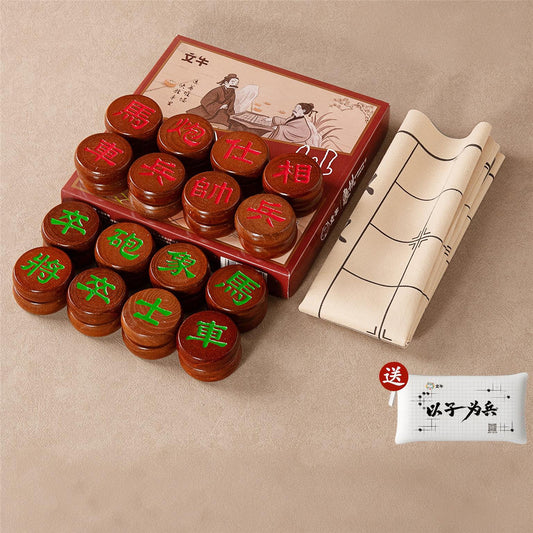
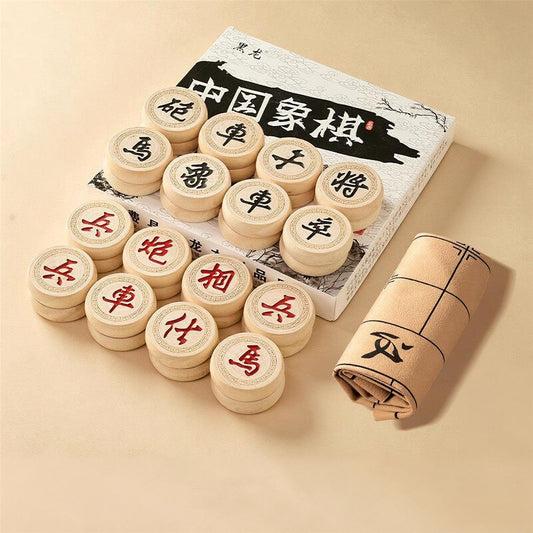
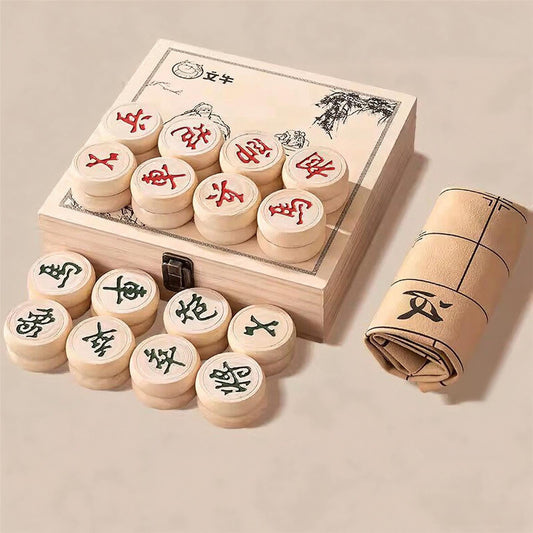
Players each have 16 pieces. The red side (usually the one rolling first) is dealt the following cards: King (帅), 2 Advisors (仕), 2 Elephants (相), 2 Horses (马), 2 Chariots (车), 2 Cannons (炮) and 5 Pawns (兵). The black side includes the corresponding: General (将), 2 Advisors (士), 2 Elephants (象), 2 Horses (马), 2 Chariots (车), 2 Cannons (砲) and 5 Pawns (卒). Name varies slightly, but both serve as the same.
The orientation is a common one that can be confusing. During the normal play, red is placed at the bottom, and black at the top. The River characters will be facing everyone, so it can be read from both sides. You can still play the game if you accidentally flip the board upside down, but the spatial aspects of opening strategies will be wrong and there won't be the psychological cue that red normally goes first.
A systematic approach to Step‑by‑Step Setup.
I suggest establishing in three well-defined sections: back rank (first rank from your point of view), second rank, and the front line. This simulates the experienced player's ability to remember the arrangement and will help you to avoid the most common mistakes.
Stage 1: The Back Rank (Row 1 for Red, Row 10 for Black)
This is your castle. Fixed and symmetrical order: from the outside in.
The Chariots should be located at the two outer intersections, (columns 1 and 9). On columns 2 and 8 put the Horses next to them. Next the Elephants (or Bishops) on the columns 3 and 7. The Advisors on columns 4 and 6. The King (or General) is in the very centre of the back rank, column 5. This is also the same for red and black pieces, but with the pieces in their respective colors.
Personal tip: I always give the students who begin the sequence lessons, to recite from the edge to the centre of the structure Chariot‑Horse‑Elephant‑Advisor‑King. It's like a royal parade – and it sticks.
Stage 2: The Cannon Rank (Row 3 should be red, Row 8 should be black)
The Cannons are on the 2nd row from your side, immediately above the Horses. This means red Cannons are to be placed in column 2 and 8, row 3 and black Cannons are to be placed in column 2 and 8, row 8. They are NOT behind the Elephants or Advisors, but behind the Horses. This is not a coincidence; by lining up the Cannon with the Horse, it has a natural attacking line in many classic openings, and it needs a “screen” (any piece) to be able to capture an enemy piece.
Stage 3: Pawn Line (Row 4: Red, Row 7: Black)
The 5 Pawns are set up one row in front of the River with the odd numbered columns – 1, 3, 5, 7 and 9. This forms an alternate gap which regulates the important cross points of the rivers. The pawns begin on all other rows - this is important for defense and aggression in the early game.
The whole layout is shown in the table below. It is a summary of the exact coordinates for each piece type; column numbers 1 - 9 (left to right as seen from red's point of view) and row numbers 1 - 10 (back to front as seen from red's point of view).
| Piece | Red Positions | Black Positions |
|---|---|---|
| King / General | (5, 1) | (5, 10) |
| Advisors (2) | (4, 1) & (6, 1) | (4, 10) & (6, 10) |
| Elephants (2) | (3, 1) & (7, 1) | (3, 10) & (7, 10) |
| Horses (2) | (2, 1) & (8, 1) | (2, 10) & (8, 10) |
| Chariots (2) | (1, 1) & (9, 1) | (1, 10) & (9, 10) |
| Cannons (2) | (2, 3) & (8, 3) | (2, 8) & (8, 8) |
| Pawns (5) | (1, 4), (3, 4), (5, 4), (7, 4), (9, 4) | (1, 7), (3, 7), (5, 7), (7, 7), (9, 7) |
After all pieces have been placed, remove them and check for symmetry. The board should be reflected on the River in all respects except the piece names. Red pieces are often circular with red lettering and black pieces are circular with black or blue lettering and are easy to tell apart.

The most frequent errors made and how to prevent them.
I've seen so many new players struggling to get the set up. In this post, the three most common mistakes and how to avoid them.
Mistake 1, players will misplace the rows of their cannon and pawns.
Many tend to automatically place the Cannons on row 4 (close to the River) and the Pawns on row 3. The red pawns should be closer to the River (row 4) and the red Cannons should be further away (row 3). The Cannons are like a battery of big guns that require protection from the infantry, not in front of the infantry.
Mistake 2: putting the pieces in the squares.
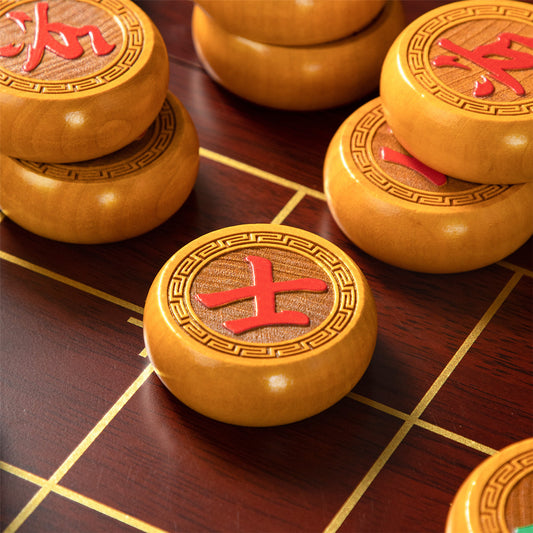
This is the longest lasting visual disturbance. In Chinese chess, each piece is on one of the intersections of the grid lines. Once you put them in the empty boxes, everything to do with the movement logic is lost, such as a Horse's “day” move being unclear, or Elephant's “field” move being unable to be measured accurately. Try to always hit the crossing points – it is good practice to hit the centre of each disc right on the crossing.
Mistake 3: Misplacing the Advisors Inside the Palace
The Palace is divided into three lines; two diagonal and one vertical. The Advisors will be placed on the intersections diagonally adjacent the King (column 4 and 6 on the back rank). Some novice novices have began to place them on columns 3 and 7 or even on the front corners of the Palace. Remember: The Advisors are not on the sidelines - they are on the sides - of the King.

What is the special relationship between the two? The Strategic Logic
It is not random, it's a thousand years of military thinking. The King's confinement in the Palace is because in ancient Chinese warfare, the general never left the command tent. The Advisors line up next to him to prevent him from being attacked directly on the diagonals. The Elephants are placed outside the Advisors because these elephants move only two points diagonally which is called a “field” pattern, and they cannot cross the River – they are a “domestic defence”.
The Chariots are on the max sides since they are the most powerful pieces that move any number of spaces orthogonally. They can sweep in from the corner, and control entire files and ranks. The Horses are set one step inwards, as they must have room to make their “L-shaped” jumps, and near the centre so that they have more room to move around.
For a tactical reason, the Cannons are positioned directly overhead the Horses. The most typical development in the opening is to move the Cannon to the centre or to the flank, and using the Horse as a screen. This alignment will minimize the number of moves required to make an attack. The Pawns are then deployed on all of the odd files in order to be able to block the opponent's Horse and to control the River. They leave spaces between which you can move through, and the Pawns block you.
The following expert tips are designed for teachers who teach children or are absolute beginnings.
For young students I use a two-step mnemonic to make it easier for them. The first one I say is: “Back rank: Car-Horse- Elephant-ADVISOR-KING” (to think of a royal convoy). Second: "Cannons above horses, Pawns on the banks. This covers everything. I also recommend that they start with the red side first as that will be the side that will be played the most, and then mirror them for black.
Another useful activity is to give one a timer and time them to see how quickly they can get it done in 30 seconds! The next few repetitions is when muscle memory is activated. I have seen it in 20 seconds, for 7-year-olds. Consistency is important, as always use the same visual anchor points – King first, Advisors and then working outwards.

Frequently Asked Questions
When both players agree to swap, is the orientation important?
Red is at the bottom of the list and has to go first. For casual games, however, it is acceptable, if both players agree, to swap colors and/or rotation, so long as they are both consistent, e.g., both switch from red to blue and/or from left to right. Usually, there is a red at the bottom, black at the top and the River text is aligned to the opposite player.
What if I lose a piece can I replace it with another?
Each piece is truly unique officially. With informal play, you may use the same sized object, but I recommend that you purchase another set as the weight and feel will make a difference in your game. Individuals or sets are sold at a low price by online retailers.
What is the difference between set up for International Chess?
In International Chess (Western chess): Pieces are put into squares, the board is 8×8 and the back rank is different (Rook - Knight - Bishop - Queen - King - Bishop - Knight - Rook). The Chinese chess board is 9 x 10, there is a River and no Queen. The placement logic is completely different and you should never try to transfer your knowledge about chess.
If I accidentally put down both Cannons on the same column can I play?
This is possible, but is against the rules and unbalanced. Ensure all misplaced items are in place prior to beginning. The beauty of Xiangqi is in balance and the opening positions are carefully prepared.
Conclusion
The first ritual when you play Chinese chess is to set up the chess board. It's a link to the tradition of over a thousand years and it instructs you in the relative values and spatial relationships of all the pieces. After you have memorised the arrangement (Chariots on corners, Horses beside, Elephants and Advisors on both sides of the King, Cannons behind the Horses, and Pawns guarding the River), you will find that the first impulse is gone and that you now have a good mental map.
In my own experience I have noticed that players who are able to memorise the setups correctly learn the rest of the game quicker. They don't have to think about where it will go, instead they focus on what to do next. So, pick up your board, follow the steps outlined above and carefully position each disc. Now you know how to deploy your forces on the battlefield.
If you still don't know, take a picture of your completed setup, and compare it to the table below. Or, better yet, have a friend ask you a question where he/she shows you a random tile and asks you which piece is that. With a little practice, you will never second‑guess yourself again. Enjoy the game and remember the first move will be the most important!