How to Learn Chinese Chess as a Beginner? A Complete Guide from Rules to Skill Improvement
Chinese Chess or Xiangqi (象棋) is one of the most popular games in the world, the game is played by millions of people in Asia and has come to be played around the world. You are interested in learning Chinese but you thought it was too difficult because you're scared of the Chinese pieces and the palaces and the river on the board, or because you don't know where to start? From a complete beginner to a confident player, this is a complete step-by-step guide to take you there, whether you're a complete beginner or an international chess player who wants to get a new challenge.
Chinese Chess: What is it? The benefits for beginners to learn it.
The game's history and significance in Chinese culture.History and cultural values of Chinese Chess.
The game of Xiangqi is a two-player, strategy game of ancient origin similar to International chess. The origin of both of these games is believed to be the Indian game Chaturanga, which was played from the 2nd to the 4th century AD. Chaturanga was introduced into East Asia via Persia and the Silk Road and over time evolved during the Tang and Song dynasties of China into the game of Xiangqi as it is played today.
Sometimes “Xiangqi” is translated as “elephant game” but its real meaning is related to Chinese military strategy and philosophy. The board is really a battlefield divided by a river, Chu River and Han Border (楚河汉界)—a historical boundary between two warring kingdoms in ancient China. The pieces are general, advisors, elephant (ministers), chariots, horses, cannons and soldiers of various ranks in the military command.
The game of Xiangqi offers more than a form of recreation; it is a glimpse into the cultural, military and strategic heritage of China spanning thousands of years.
Chinese Chess vs International Chess and Go
Even if you have played international chess and/or Go, knowing the differences will help you appreciate the uniqueness of Xiangqi.
The most obvious difference is the chessboard: Chinese Chess is played on a 9×10 board with 90 intersections for pieces as opposed to 64 squares in International Chess. The board has a river running down the middle, and palaces (boxes on the board 3x3) which contain generals and advisors and limit their movement. The pieces are also different: Xiangqi features cannons (which capture by jumping over a screen) and soldiers which get to move sideways after crossing the river. Forced stalemate (困毙) is a victory in Xiangqi – it is not a draw as in international chess.
Chinese Chess vs. Go: Go is a territory-capturing game in which players place stones to enclose empty space and is played on a 19×19 board. Compare to Xiangqi which is a direct conflict game with only one goal—checkmate the opponent's general. Go's main emphasis is on positioning and influence while Xiangqi emphasizes tactical calculation, coordination of pieces, and direct attack.
What are the skills that can be acquired from studying Chinese Chess?
Learning Xiangqi cultivates a series of cognitive skills which can be applied in real life. There is a requirement for logical thinking, each play must be considered as to its effects. It enhances strategic planning as you keep one eye on your opponent's threats, while planning ahead. The uncertainty of making decisions increases as the trade-offs between capturing this piece versus improving position are continually made.
There is also training of a pattern recognition in Xiangqi. With practice, common tactics such as "double chariot check" and "cannon behind horse" become second nature. There's a lot of strategy involved in the game—over aggressive play can be a liability, and it's a good lesson in life to learn how to stay cool during a game when you're down.

How to Prepare for new Chinese Chess Learners?
Selecting the best Chinese Chess set is crucial.
While the game doesn't require any high-tech equipment to get started, the proper set will make Xiangqi more fun.
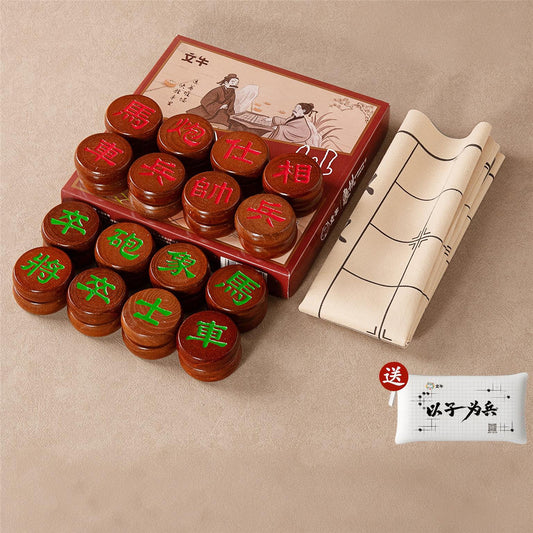
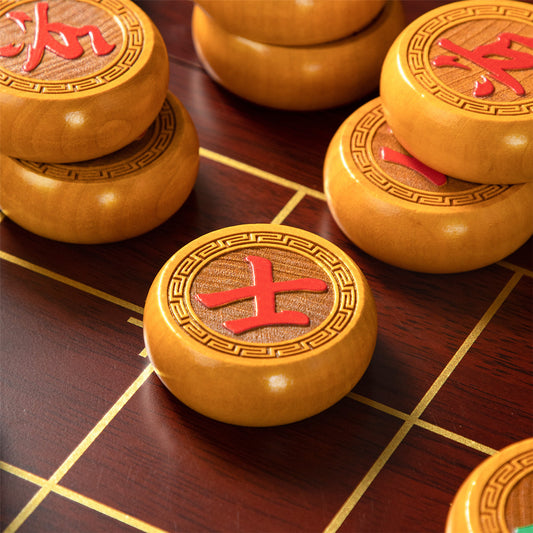
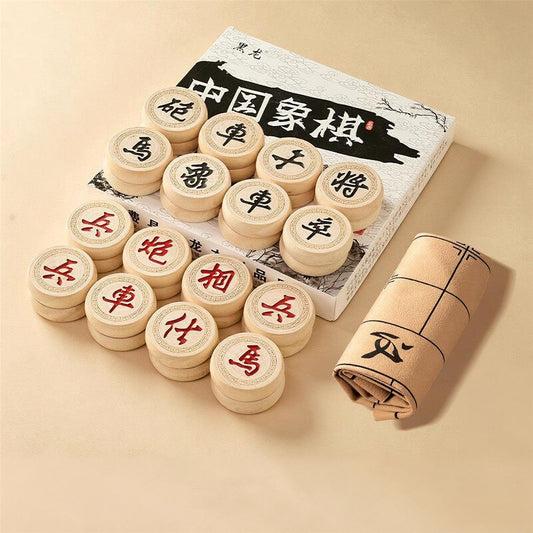
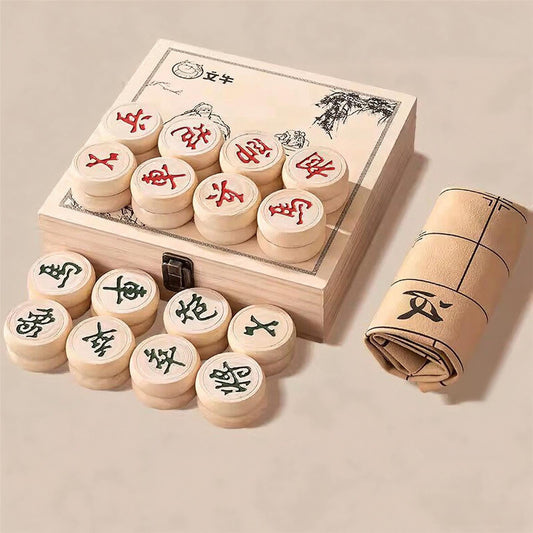
Simple wooden board and pieces: A simple board made from wood with flat round pieces are just fine for beginners. They are usually carved from wood or plastic and have Chinese writings on them. If you don't know Chinese, try sets that have graphic blocks with symbols rather than Chinese characters or an app that has digitized pieces with English labels.
Wooden vs. magnetic vs. portable boards: The wooden boards have the most traditional look and are ideal for the home. Magnetic boards are great for travel or for playing outside as the pieces are magnetic. Portable/roll up boards are lightweight and easy to bring to chess clubs or parks and are typically vinyl or silicone. A large board (approx. 40 - 50 cm) with distinct markings for the palace and river is best for serious study.
When buying a beginner's set,make sure that the board has the palace boundaries indicated on the board (the X-shaped lines at both ends) and the river indicated in the middle of the board. It is important for the pieces to be easily distinguishable from red and black sides. Most of all, be able to recognize each piece; if they are too small or poorly engraved, then your learning process will be slower.
Chinese chess is a game that consists of three components: pieces, rules, and strategy.The Chinese chess game has 3 elements: pieces, rules and strategy.
The board structure: Xiangqi board is made of 9 vertical lines (files) and 10 horizontal lines (ranks), giving 90 intersections for the pieces to be placed. The board is segmented by a river in the middle that is symmetrical in an east-west direction. There are palaces, also known as the nine palace, at both the ends of the board, each palace is 3×3, it is marked with diagonal lines.
Thirty two pieces: Every player has 16 pieces (7 different types). The red side has: 1 General (帅), 2 Advisors (仕), 2 Elephants (相), 2 Horses (马), 2 Chariots (车), 2 Cannons (炮), and 5 Soldiers (兵). The pieces on the black side are the same but with different characters: 1 General (将), 2 Advisors (士), 2 Elephants (象), 2 Horses (马), 2 Chariots (车), 2 Cannons (砲), and 5 Soldiers (卒).
The characters on the pieces are different for the two colors, although the pieces themselves are the same (red vs. black). This tradition goes back through the ancient days when it was too costly to use coloured ink, so different characters were used for this. Red plays first in official play.

Chinese Chess: Learn the Basic Rules
How to Read the Chinese Chess Board
Before adding any pieces, the board has some important characteristics to know.
The palace (九宫): At each end of the board, the palace is a 3×3 square with “X” diagonals. Advisors and/or the General can move within this area. The General will NEVER move from the palace (it is illegal to move the General out of the palace).
The horizontal space in the center of the board (river) Elephants are not allowed to cross the river, they can only go across their own side of the board. After crossing the river, soldiers are able to gain extra movement options.
Setup: All the pieces are positioned on the first 5 ranks of each player's board. In the back rank and then outwards: Chariots are setup on the corners Horses are setup next to the Chariots Elephants are setup next to the Horses Advisors are setup next to the Elephants and the General is setup in the middle. The third rank from the bottom of the file, 2 files in from the edges, are cannons. On each crossing in the fourth rank soldiers are lined up. After awhile, it's an automatic process.
All 7 Pieces Movement Rules in detail.
The General (帅 / 将): The General can move forward, backward, left or right 1 point at a time, only in the palace. Each of the two Generals may not be directly opposite the other on their own file with no piece in between them. This is known as “flying general” rule.
Advisor (仕 / 士): Advisors can only move one point diagonally, and may not leave the palace. They are the bodyguards of the General.
Elephant (相 / 象): Elephants move two squares diagonally (like the bishop moves in international chess). But they can't cross the river and are blocked by anything in their way (also known as “塞象眼”).
Horse (马): The Horse steps 90° followed by 45° as it steps out. The Horse is similar to the international chess knight, except that it can be blocked, that is, no piece is directly beside it in the first half of its move. It is called “hobbling the horse's leg” (蹩马腿).
Chariot (车): The Chariot can move straight up or down or left or right any number of points, just like a rook in international chess. It's the strongest move on the board.
Cannon (炮 / 砲): The Cannon moves like a Chariot (any distance orthogonally) when not capturing. But to capture, it must jump over exactly one piece (called the “screen” or 炮架). The screen can be either a friendly or enemy piece. This unique rule makes the Cannon a fascinating tactical piece.
Soldier (兵 / 卒): Soldiers will be able to move one point forward before crossing the river. Once they cross the river they can also move one point sideways, but NOT backwards.
What is the meaning of Do Check, Checkmate and Capture in Chinese Chess?
Capture (吃子): A piece moves along the same rules as a normal piece, and captures an enemy piece by moving to the square that it occupies. Captured piece is taken off the board.
Check (将军): If a player's General is directly attacked by an opponent on the next turn, the player is said to be “in check”. The player must react quickly and move the General away from the attack, block it or capture the attacking piece.
Checkmate (将死): If a player is in check and there is no possible move to remove the check, then it is Checkmate. The game is won as soon as and only if the player who delivers checkmate says so.
How to Win and Lose in Chinese Chess
Checkmate wins: The most ordinary of the wins is when you can trap the opponent's General without it having any means of escape.
Stalemate wins (困毙): In Xiangqi, if a player has no legal moves, but is not in check, this is not a draw, but a win for the player who forced the stalemate. This is a significant difference from international chess and in the way that it adds strategic depth.
In some situations, perpetual check (repeated checking without any progress) can be drawn by mutual consent, or, in case of a perpetual check, where one side is always checking and the other is always replying (not in Xiangqi.com rules, but in others, this is a draw).

A self-taught beginner's sequence for learning with correctness.
It is one of the most common faults made by the beginning player: he starts with openings, instead of going from endgames to openings. This is the tried-and-tested order recommended by pro players.
The Pieces and Movements should be learned in Phase 1 (1-3 days).
Objectives for this stage: To identify all 7 types of pieces on both red and black sides, to learn the movements of each piece, to be able to place pieces on the board from memory.
Initially, all the pieces should be correctly in place. Work on the movement of each piece around the board, moving the Chariot around on open squares, practise the L-shaped movement of the Horse (being careful not to capture any pieces) and try the one-way movement of the Cannon – capturing pieces. Take time on the Horse and Cannon, these are the pieces that the beginner has the most difficulty with.
When you can correctly place the board without the assistance of a diagram and can correctly name the movement of each piece you are ready for the next step.
During Phase 2, students will learn basic tactics and checkmate patterns (1-2 weeks).
Work on: Checkmate Techniques, Capture Skills, and the Coordination of the Basic Pieces.
The core of Xiangqi is to checkmate the opponent's General – so the first thing you need to learn is how to checkmate. These are the absolute necessary patterns to learn for checkmate:
Double Chariot Check (双车错): Deliver two Chariot checks at the same time, trapping the General in a corner which it has no way to escape from.
Cannon Behind Horse (马后炮): The Cannon is hidden behind your Horse, thus protecting the Horse from enemy attack.
Heavy Cannon (重炮): Combining two Cannons on the same file to make a checkmate; one of the Cannons blocking the other.
Exploit General's rule of not facing directly with each other (Bare-face Check / 对面笑): Using your General to “attack” (check) the enemy's General along an open file.
Memorise these checkmate patterns until you are able to spot them at a glance. A useful rule - the ability to make a forced checkmate in three moves from a position.
Students will complete their learning on Openings in Phase 3 (1 Month).
One of the key principles when playing Xiangqi: "万事开头难 (Everything is hard at the beginning)". You can't start the day off wrong. However, don't learn long opening sequences as a rote memorized routine, but rather learn the principles.
For beginners, the following openings are recommended:
A common and aggressive opening, known as Central Cannon or 当头炮. Red moves to Cannon to the center (C2=5 or C8=5), directly attacking opponent's midphi Soldier. This move is used in about 70% of all games. It will suit players with an attacking style of play.
Most popular defense against the Central Cannon is Screen Horses (屏风马). Both Horses between the Cannons are developed by Black to help defend their own central Soldier. It's a good and secure system and essential for every beginner to be aware of.
Elephant Opening (飞相局): A more conservative opening, Elephant (相) opening first. Emphasizes defensive and positioning skills, ideal for those who enjoy a more strategic game.
Pawn Opening (仙人指路): 1 step (P7+1 or P3+1) for Red's Soldier. A move that is flexible and ‘waiting' and allows options.
Select one that works for you and really focus on that one and then work on the others later.
In Phase 4, the student will analyze the Middlegame and Endgame.
Tactical battles - piece exchanges, attacks, defenses - take place in the middlegame. Some of the important lessons in the middle game are:
Piece Co-ordination: To learn how to use your Chariots, Horses and Cannons to work together to greatest effect.
Exchanges (兑子): Making the decision to make an exchange or not.
Sacrifices (弃子): At times, making a sacrifice results in a winning attack.
Endgame is all about turning the advantages into victories. Other important endgame skills are: Value of pieces (see below); Basic checkmate patterns with limited pieces; Stalemate tactics.

The top 5 techniques that every beginner should learn.
In the game, the players do not have to concede any material for free.In the game players are not allowed to concede material for free.
When it comes to trading, it can help you know if a particular piece is worth trading or not. These are approximate values which may vary dependent on the location, but here are the reference points you look out for:
| Piece | Value (Points) | Notes |
|---|---|---|
| Chariot (车) | 9 | The most powerful piece; “one Chariot equals ten pieces cold” |
| Cannon (炮) | 4.5 (opening) / 4 (endgame) | Powerful in opening, weaker in endgame when fewer screens exist |
| Horse (马) | 4 (opening) / 4.5 (endgame) | Easier to block in crowded positions, stronger in open endgames |
| Advisor (士/仕) | 2 | Defensive piece |
| Elephant (象/相) | 2 | Defensive piece |
| Soldier (兵/卒) | 1 (before river) / 2 (after river) | Value increases after crossing |
The right time to make a sacrifice: It's okay to sacrifice something at the right time, such as sacrificing a piece to checkmate, or sacrificing a less active piece for a more active one. However, as a novice, don't make any unneeded sacrifices unless you have a clear winning strategy.
There are 5 mistakes that most beginners make.
Mistake 1: No defence and all out attack. The new player may be keen to move their pieces quickly without showing care for the safety of his General. Remember to always look for a move that doesn't expose your General.
Mistake 2: Moving the same piece several times in the beginning. All pieces are developed in the opening and no piece is moved twice. It is said: “A poor player does not move the Chariot in the first three moves” – make your Chariots early!
Mistake 3: Fail to take into account your opponent's threats. You can easily get caught up in what you're going to do, and forget what your opponent is going to do. Ask the question “What is my opponent threatening?” each time they are about to move.
Mistake 4: Greedy captures. Every new player's goal is to capture Soldiers, but this can be very time consuming and will force you to move away from your position. Do not take images just for the sake of taking images: take images only when it enhances your position.
Mistake 5: Forgetting the endgame. Lots of players learn the openings very well and never endgames. This is the opposite of what you need to learn to get better at endgames—you should learn to coordinate pieces and find patterns for checkmate that will help you at all phases of the game.
Developing skills that lead to “Three Move Ahead” Calculation Skills.
That's what differentiates stronger players from weaker ones is the ability to calculate variations. The following are some tips for developing this ability:
Predict your opponent's strong reply: For each move that you think of, ask yourself: “If I move like this, what will my opponent's strongest move be?”
Develop a move list: Do not consider all possible moves, but select 3-4 and analyze each one. This simplifies the calculations.
Minimize mistakes by recognizing patterns and tactical motifs: By being familiar with the basic checkmate patterns and tactical motifs, you will be able to calculate much faster and with less mistakes. Do some endgame puzzles to develop this intuition.

The Classic Opening Systems that Every Beginner should know.
Central Cannon Opening (中炮): Suitable for Beginners.
Why it's recommended: Central Cannon is easy to perform, aggressive and helps you learn the concept of controlling the center. This opening is adopted in about half of all Xiangqi games.
Basic idea: Red will play the Cannon to the center file (C2=5 or C8=5) with an aim of hitting the center Soldier (C5) of the Black to the head.Basic idea: Red will play the Cannon to the center file (C2=5 or C8=5) to aim the centre Soldier (C5) of the Black to the head. This instantly poses threats and obligates Black to act.
There are some defenses against black: The most popular is to play Screen Horses (屏风马). Other forms of cannon include: Same Direction Cannon (顺炮) and Opposite Direction Cannon (列炮).
Typical sequence: 1. C2=5 (Red makes Horse) H8+7 (Black moves Horse). 2. The race for H2+3 (Red can develop Horse) is for R9=8 (Black can develop Chariot). 3. R1 is 2, which means that Red develops Chariot.
Screen Horses Defense is The Solid Choice (屏风马).
The reason why Screen Horses is recommended: It's the most effective defense against Central Cannon and you will learn solid defensive practices.
Basic idea: Black is developing both Horses between the Cannons to defend the center. This is a position that is flexible and resilient and can't be broken down.
How to play it: Red then plays C2=5, Black plays H8+7 (one of the Horses moves to the center). Red takes B1 and Black takes H2+3. The Soldiers are protected from attack by the Horses “screening” them.
For the Patient Player, Elephant Opening (飞相局) is a game.Elephant Opening (飞相局) is a game for the Patient Player.
The rationale behind: This is an opening that is most suited to positional play and defense. Less tactical than the Central Cannon and it will help you to understand piece coordination better.
Simple idea: Red advances an Elephant (相) and consolidates the defense and sets up pieces behind the Elephant. A “slow” opening that is an opening without early confrontation.
Not all openings are created equal.Not every opening is suited for a beginner.
For beginners, it makes no sense to memorise 20 opening theory moves. Here’s why:
Rovable openings depend on the answers to what your opponent says. You can only memorize one line and if your opponent tips off that you're lost. It's much better to know the principles of openings than to memorize variations.
Your opponent will not play “book” moves at beginner level. Attempting to pressure an opponent with a memorized sequence against them who makes “incorrect” moves tends to have the opposite effect.
Early, endgames and tactics are more important. A player with 10 checkmate patterns will win over a 10 opening player, 100% of the time.
Now concentrate on one opening system (Central Cannon is ideal) and explore its fundamentals. All the rest is left up to experience.

How to practice and enhance your Chinese Chess skills
A 30 minute practice plan, to be performed daily.
Consistency beats intensity. Here is an average day's schedule:
A game and/or a study of a checkmate pattern will be reviewed: 10 minutes. Play a brief game with strong players or play a particular checkmate motif. Utilize the use of apps or books with diagrams.
10 minutes:Work through end game puzzles. The best puzzles to help calculation and pattern recognition skills are endgame puzzles. Begin with 3 move checkmate puzzles and then move to more difficult puzzles.
10 minutes:Play a game. Challenge AI player (set to easy) or other novice online player. It's not about winning, it's about what you learned!
Play More Games, More Game, More Games!
There’s no substitute for actual play. It's OK to lose! All of the time loss is a learning opportunity. Play against players who are a little bit stronger than you—it is better to get better by playing against the tougher competition than against something that is even easier.
If possible play over the board using a physical set. Increased tactile experience and use of the whole board without a screen increases board vision. It's a good place to learn about chess, but don't win many first off the blocks when playing in the parks!
Every game has a purpose and the fastest way to improve is to review the game after it occurs.
It's better to take a time to see your games than to play them. The following is a simple (review) process:
Know the most important moment. Identify the turn the game went off the rails on (the moment you got the upper hand or it went out of control).
Find a better move. Come back to that position and search for a better alternative. Seek out help from a more powerful player or the engine.
Summarize the lesson. List one thing you learned as a result of this game. It might be "don't leave my Cannon undefended" or "develop my Chariots faster.
This process will create a mental checklist of patterns and errors to prevent.

Some recommended learning resources have been provided for self-taught beginners.
Chess is an ancient game that is played worldwide.Chess is an old game that has been around the world.
Question 1: Human vs. AI: Play with computer at the lowest difficulty. This is a good way to learn at your own speed in a time-less manner. Continue to add to the difficulty as you gain proficiency.
Online play: There are platforms such as Xiangqi.com and Lichess which provide online matchmaking opportunities; players can find others to play with who have a similar level of skill. It is important to play against actual players to improve.
Game analysis: After playing a game you can analyze, and see exactly where you went wrong and can see what you should have done. Take advantage of this feature on a regular basis.
How to use widgets & instructional resources.How to use widgets and instructional resources.
Basic rules and piece moves: Find videos that show the basic rules and piece moves. It's easier to see than to read about the Horse's L-shaped move, and the Cannon's jump-capture in action.
Opening explanations: Identify explanations which explain why certain opening moves are played, rather than what the moves are. If you know why you need to make the move, you'll remember it more easily.
Analyzing games: It's a great benefit to observe the analysis of strong players, particularly of games between beginners, as it will teach you what commonly goes wrong and how to avoid it.
The following is a list of books that students are recommended to use for self-study.
Books for beginners: Start learning the rules, basic checkmates and simple endgames. Visual Learners will benefit from books that have a lot of pictures.
Opening encyclopedias: When you have selected the opening you like (such as Central Cannon), look for a book about that particular system. Delve into the subject, don't read multiple openings superficially.
Endgame manuals: Endgame books are based on piece coordination and concrete checkmate patterns. These are the most useful study materials in order to enhance your overall game.
Becoming a part of the Xiangqi Community
Reddit and Discords: Participate in Xiangqi Reddit and Discord communities.Dedicated Chess Websites: Engage in Xiangqi Communities on Chess Websites. Question, present your own games for feedback, and accept feedback from higher-level players.
Chinese Chess Clubs: There are Chinese chess clubs or cultural centers for people to play in at many cities. It's great to be able to play over-the-board with actual pieces against someone who has experience playing against you.
Tournaments: If you feel you're comfortable with the rules and you've had some experience, try playing a local tournament. Competition enhances learning (with both success and failure).
Common Questions on Learning Chinese Chess
How much time does it take to learn Chinese chee from the scratch?
The basics of the game and the movements of the pieces can be taught in 1 afternoon. It takes 1–2 weeks of daily practice to achieve a competent beginner level, which allows one to play a full game without breaking any rules and be able to identify basic threats.
How many times per day should I practice so that I can get to the beginner level?
This will take 30 minutes a day and will help them make steady progress. It's better to be consistent than to do marathon sessions. A 30-minute period of focused study, puzzles and play (10 minutes each) is better than two hours of unfocused play!
Is Chinese Chess still possible for Adults?
Absolutely. The skills of Xiangqi are not the physical ones or the youth. A large number of players are adult and attain good amateur levels. The difference lies in the deliberate practice which means studying, not just playing aimlessly.
Which of the two is easier? Chinese Chess or International Chess?
They're not the same and not “easier.” Xiangqi is played on a larger board (90 intersections, versus 64) with more limited piece movement (Elephants can't cross the river, palace bound Generals and Advisors). In international chess, there is no such rule as that of the Cannon. The rules are much simpler to understand but equally challenging in Xiangqi, where most players can easily learn them, but struggle to master them.
Openings or Endgames?
Endgames first. Always. Endgames have been designed to teach you the basics of chess: the work of pieces together and the ability to checkmate. The idea of the openings is to get to a playable middlegame, but without any idea of how to finish a game, the openings are useless. Openings, Middlegame tactics then Endgames. The sequence that has been proven to work successfully by experienced coaches.
What are the ways of developing my Chinese Chess calculation?
Each day, try to complete endgame puzzles. Use simple puzzles that are 1-2 moves and then gradually increase the difficulty. Take time to ponder and experiment variations over slower time controls; don't rush. Play through the games and analyze the errors in your calculations. As time goes on, your brain develops pattern recognition, which will make it faster and easier to calculate.

Your Learning Roadmap - From Beginner to Strong Player.
Beginner level (with ratings of 0-1000).
Objectives: To learn the rules and piece movements. Identify simple patterns of checkmate (double Chariot, Cannon behind Horse, heavy Cannon). Play entire games without committing any illegal moves.
The subjects to study: Piece moves → simple checkmates → simple end games. Compete with Artificial Intelligence at low level. Pay no attention to openings, just apply basic rules (develop pieces, control-center, protect King).
Normal time: 2-4 weeks (with practice).
Intermediate Level (1000-1500 ratings).
Skills: Be familiar with 1 or 2 openings (Central Cannon (Red) and Screen Horses (Black) well). Avoid obvious blunders. Perform basic tactical movements. Know and make appropriate exchange decisions for the values of the pieces.
To study: The opening principles of your system(s) → intermediate checkmate patterns → further endgame practice. Begin to play online against humans. Review every game.
Typical time: 2–4 months.
Advanced Amateur Level (1500+, or above).
Learning Objectives: To build up an opening repertoire. Determine 3-4 steps ahead regularly. Know about position (space advantage, piece activity). Study master games.
Study: Build on your initial knowledge – study middlegame strategy – study advanced endgames. Frequently play against tough competition. Play all games in an engine or with better players and analyze each game.
Typical time: 6-12 months or longer depending on the amount of practice.
There are a lot of hours and commitment needed to reach “amateur top” level, where you can compete on a level playing field in your local tournaments. But, it is a rewarding journey and each step gained more knowledge and enjoyment.
Final Summary
Chinese Chess is an easy-to-understand game that is easy to learn:
Learn rules and piece movements → your building blocks. Learn endgammes and checkmate patterns → shows you how to win. Research openings → in relation to understanding the endgame. Play lots of games → and review all of them. Practice every day - even 30 minutes a day is good - consistency is better than intensity.
Avoid trying to get a lot of openings, or memorize a long sequence of openings. Experienced players always say that they first learn the endgame and then the beginning. Know the value of pieces to not lose material for free. Don't succumb to the typical new player's errors such as over-aggression, capture too much and ignoring defense.
Above all, have fun doing it! It's a game that can be enjoyed in numerous ways and at various levels. The more you know, the more you come to realize there is to learn. As long as you're willing to work and take the proper way to learn, you will find that you can better your skills very quickly.
Start today. Design a board, familiarize yourself with the piece movements and play your first game. The river waits and the battle is yours.