How to Play Chinese Chess (Xiangqi): A Beginner's Guide
Chess, in China called xiangqi (象棋), is a strategy game for two people that is played on a 9x10 board, with 16 pieces and one goal: to checkmate the opponent's general. If you are already familiar with international chess, a lot of ideas will be familiar, but the board, the river, the palace and the cannon is what makes xiangqi unique. It is very popular in China, Vietnam, where a similar game is known as cờ tướng. This guide covers the principles, set-up, piece movement and beginning strategies for the beginner. It also points out some rules that might be different from game to game, book to book and site to site.
What Is Chinese Chess (Xiangqi)?
Xiangqi is a perfect-information game, that is, the two players can see all the pieces on the board at all times. No hidden cards or dice. While there has been some debate about the origins and evolution of the more primitive forms of the modern game, there is little doubt that the modern version of the game has a long history. It has one of the most easily recognizable features in the form of the river that splits the board in two. The river is traditionally marked with the words 楚河 (Chu River) and 漢界 (Han border), by the competition between the Chu and Han states of ancient China.
The Goal of Xiangqi: Checkmate the Opponent's General
They each have an army with a general (帥 for Red, 將 for Black). You win a game if you checkmate the opponent's general, putting the opponent's general in check when the opponent has no legal move to escape the checkmate.
If the attacking piece can be captured or the attack blocked, or the general can be moved to safety, the player may do so. During normal games the general is not taken prisoner. The game is over if there are no legal moves to check.
Another rule that inherees in Xiangqi and that is not shared by its international chess counterpart is that if there is no legal move whatsoever, then the player who is to move loses even if the player's general is not in check. This position is known as "stalemate" in international chess, and leads to a draw. Normally, the winner of xiangqi is the player with the most legal moves.
The difference is that a player need not only be able to give their opponent a direct checkmate; they can defeat the opponent by disallowing all possible moves they might make.
Learn about the Board, River and Palaces.
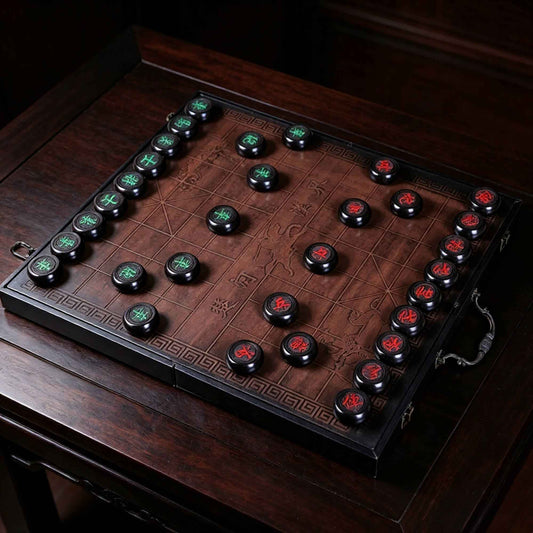
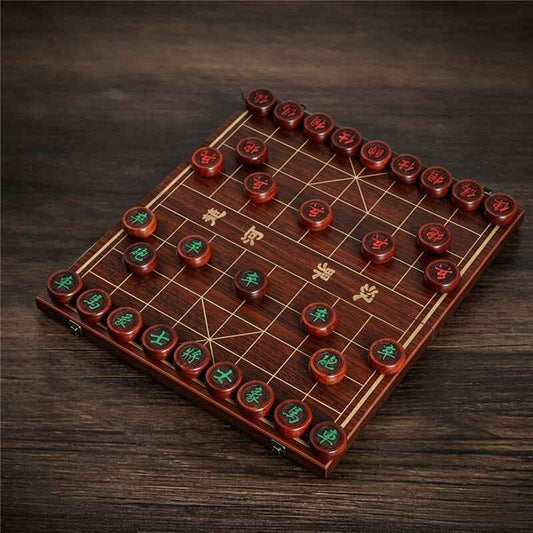
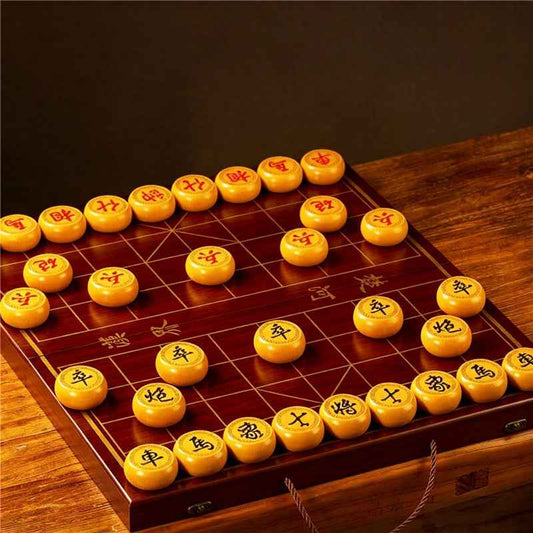
There are 90 places where the pieces play on a xiangqi board, which is made of 9 ranks (horizontal lines) and 10 files (vertical lines). Pieces are placed at the intersections and not in squares. You can see this one of the first differences, if you know international chess, if you don't, you'll learn about it.
Files are numbered 1-9 starting at player's right hand side. The numbering is opposite from each player's point of view due to the players being on opposite sides of the court. When reading game records, this convention is very important.
The river is in position 5 and 6. It is not obstructed by movement: chariots, horses and cannons are able to move across it without hindering and the generals line of attack can run across the board at any time if no piece blocks it. The river has two major (and only two) impacts on pieces.There are only two major (and only two) impacts the river has on pieces. Elephants are unable to cross and soldiers are able to move sideways once they cross.
There are also palaces for each side: on each side, there lies the centre three ranks (points) of the players, which are 3-by-3 in the centre of the board. There is a cross (X) in the center of the palace, which is made up of two intersecting diagonals. The palace is important for defence, and is the centre for many checkmate patterns, and the general and advisors must stay in this zone.

Who Moves First? Red vs. Black!
Red can move first, and Red pieces are typically located towards the bottom of diagrams and screens. The two sides employ different piece characters, although there are characters which are very similar or the same in simplified sets. The general's of Red and Black is 帥 and 將 or 帉 and 将 respectively.
The first player, Red, has the advantage of starting the first move but it is up to their hand to make the move and is dependent on the position. In the simplest of terms, the players alternate turns with red starting out.
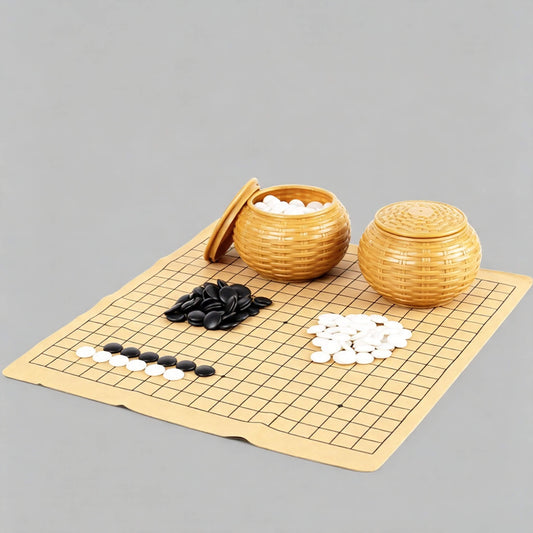
Chinese Chess vs. International Chess and Go.
Sometimes newcomers tend to classify xiangqi with other popular board games. Just a quick look at the similarities and differences of each game reveals the differences.
| Feature | Xiangqi (Chinese Chess) | International Chess | Go |
|---|---|---|---|
| Board | 9 × 10 lines; pieces on intersections | 8 × 8 squares | Usually 19 × 19 lines; stones on intersections |
| Pieces per side | 16 | 16 | Stones are placed one at a time |
| Objective | Checkmate the general | Checkmate the king | Gain more territory than the opponent |
| Distinctive features | River, palaces, cannon, flying general rule | Castling, en passant, pawn promotion | Captures by surrounding; stones do not move |
| No-legal-move position | Loss | Stalemate is a draw | Governed by Go's own rules |
The concept of trapping a royal piece is common between Xiangqi and international chess, and is different from the concept of Go. Unlike other countries there is no queen in Xiangqi, but there is a cannon which can capture by jumping over another piece. These differences lend it a tactical character in all its aspects.
How to Set Up a Chinese Chess Board
Setting up the board correctly is the first practical skill, and it takes only a minute once the pattern is clear. The key is to remember that every piece goes on an intersection, never inside a square. For more information about how to set up a Chinese chessboard, see: How Do You Set Up a Chess Board?
The 16 Pieces Each Player Starts With
Each side begins with 16 pieces, giving 32 pieces on the board at the start. A player's army contains:
- One general
- Two advisors
- Two elephants
- Two horses
- Two chariots
- Two cannons
- Five soldiers
The two armies have the same structure. Once you know how to set up one side, you can mirror the arrangement for the other.
The Standard Starting Position for Red and Black
The back rank holds the nine main pieces. From one corner to the other, the order is chariot, horse, elephant, advisor, general, advisor, elephant, horse, chariot, with the general in the center of the palace.
The two cannons stand on the third rank from each player's side, directly in front of the horses. The five soldiers occupy the fourth rank, on the first, third, fifth, seventh, and ninth files. These are the points marked with small cross-shaped guides on many boards.
The table below shows the starting position from Red's side. The file numbers run from Red's right to Red's left.
| Rank | 9 | 8 | 7 | 6 | 5 | 4 | 3 | 2 | 1 |
|---|---|---|---|---|---|---|---|---|---|
| 10 | 車 | 馬 | 象 | 士 | 將 | 士 | 象 | 馬 | 車 |
| 9 | · | · | · | · | · | · | · | · | · |
| 8 | · | 砲 | · | · | · | · | · | 砲 | · |
| 7 | 卒 | · | 卒 | · | 卒 | · | 卒 | · | 卒 |
| 6 | · | · | · | · | · | · | · | · | · |
| River | ~ | ~ | ~ | ~ | ~ | ~ | ~ | ~ | ~ |
| 5 | · | · | · | · | · | · | · | · | · |
| 4 | 兵 | · | 兵 | · | 兵 | · | 兵 | · | 兵 |
| 3 | · | 炮 | · | · | · | · | · | 炮 | · |
| 2 | · | · | · | · | · | · | · | · | · |
| 1 | 俥 | 傌 | 相 | 仕 | 帥 | 仕 | 相 | 傌 | 俥 |
The general begins in the center of the palace. The cannons start on the second and eighth files, and the soldiers start on alternating files. These positions are the same on both sides, mirrored across the river.

Chinese Chess Piece Names: General, Advisor, Elephant, Horse, Chariot, Cannon, and Soldier
Different books and apps use different English names for the same pieces. Some call the chariot a rook, the horse a knight, and the elephant a bishop, borrowing terms from international chess. These comparisons can be useful, but the pieces do not move in exactly the same ways.
The following table lists common English names, the traditional piece characters, their pinyin, and the letters used in WXF notation.
| English Name | Red Piece | Black Piece | Pinyin | WXF Letter | Count per Side |
|---|---|---|---|---|---|
| General | 帥 | 將 | Shuài / Jiàng | K | 1 |
| Advisor | 仕 | 士 | Shì | A | 2 |
| Elephant | 相 | 象 | Xiàng | E | 2 |
| Horse | 傌 (or 馬) | 馬 | Mǎ | H | 2 |
| Chariot | 俥 (or 車) | 車 | Jū (also pronounced "chē") | R | 2 |
| Cannon | 炮 | 砲 | Pào | C | 2 |
| Soldier | 兵 | 卒 | Bīng / Zú | P | 5 |
Simplified-character sets commonly use 帅, 仕, 相, 马, 车, 炮, and 兵 for Red, and 将, 士, 象, 马, 车, 炮, and 卒 for Black. Character forms can vary between sets.
The WXF letters are useful when reading international game records. For example, C2=5 means the cannon on file 2 moves sideways to file 5. The C stands for cannon, and = indicates a sideways move.
How Do Chinese Chess Pieces Move?
The seven piece types have different movement rules. The general, advisors, and elephants are restricted to specific zones, while the chariot, horse, cannon, and soldier can operate across more of the board.
Learning these restrictions early helps prevent illegal moves and makes it easier to recognize tactical opportunities.
General (将/帅): Moving Within the Palace
The general moves one point at a time, horizontally or vertically, and must remain inside the nine points of the palace. It captures in the same way it moves.
Because it cannot move diagonally, the general has at most four possible destinations. Friendly pieces, enemy attacks, and the palace boundaries may reduce the number of legal moves.
A special restriction called the flying general rule governs how the two generals interact. The generals may never face each other on the same file with no piece between them. Any move that would leave them facing each other directly is illegal.
This rule has an important tactical effect. A piece standing between the generals may be preventing an illegal face-to-face position. Moving it away can expose its own general, so players must consider the entire file before moving a blocking piece.
Advisor (士/仕): Moving Diagonally
The advisor moves one point diagonally and must remain inside the palace. This means it can occupy only five points: the four corners and the center of the palace.
Advisors are mainly defensive pieces. They help protect the general and can block attacking lines, although their restricted movement means they cannot respond to every threat.
Advisors capture in the same way they move.
Elephant (象/相): Moving Two Points Diagonally
The elephant moves exactly two points diagonally and cannot cross the river. It therefore remains on its own side of the board.
Each elephant has seven possible points on its side, but its movement can be blocked. If a piece of either color occupies the intermediate diagonal point, known as the elephant's eye, the elephant cannot make that move.
This rule is easy to overlook. An attacking piece placed on an elephant's eye can prevent the elephant from moving to a key defensive position.
Horse (馬/马): The Horse-Leg Blocking Rule
The horse moves one point orthogonally and then one point diagonally outward, in a pattern similar to the knight in international chess. The crucial difference is that the horse can be blocked.
If a piece of either color occupies the adjacent orthogonal point in the direction the horse wants to move, the horse cannot make any move that begins through that point. This is known as blocking or hobbling the horse's leg (蹩马腿).
For example, a horse may appear to have a clear diagonal destination, but if its leg point is occupied, that destination is illegal. In the center of the board, a horse can have up to eight possible destinations, provided the relevant leg points are clear.

Chariot (車/车): Moving Along Ranks and Files
The chariot is generally the most powerful piece in xiangqi. It moves any number of unobstructed points along a rank or file and captures by moving onto the point occupied by an enemy piece.
It cannot jump over other pieces. A chariot blocked by its own horse or soldier cannot travel through that piece.
Because the board opens up as pieces move, a chariot on a clear file can exert pressure over a large area. Beginners should look for opportunities to bring their chariots into play rather than leaving them trapped behind other pieces.
Cannon (砲/炮): Capturing Over a Screen
The cannon moves like a chariot when it is not capturing, sliding along ranks and files through empty points. Its capture method is different.
To capture, the cannon must jump over exactly one piece, called the screen, and land on the next piece beyond it. The screen can belong to either player, but there must be no other piece between the cannon and the screen or between the screen and the target.
This creates several important restrictions:
- A cannon cannot capture an adjacent piece if there is no intervening screen.
- It cannot jump over two pieces to capture a target.
- It cannot capture without a screen.
- To give check by a cannon, there must be exactly one piece between the cannon and the opposing general along the attack line.
Because its attacks depend on the pieces remaining on the board, a cannon can be especially effective when there are many potential screens. Its tactical opportunities often change as pieces are exchanged.
Soldier (卒/兵): Moving Before and After Crossing the River
Before crossing the river, a soldier moves one point straight forward and cannot move sideways or backward.
After crossing the river, it can also move one point sideways, left or right. It still cannot move backward.
Soldiers capture in the same way they move. Unlike pawns in international chess, soldiers do not promote when they reach the opponent's back rank. They can continue moving sideways if a legal move is available.
Although an individual soldier is relatively weak, advanced soldiers can create threats near the enemy palace, especially when supported by a chariot or horse.
Chinese Chess Moves at a Glance
| Piece | Movement | Capture Method | Key Restriction |
|---|---|---|---|
| General | One point horizontally or vertically | Same as movement | Must stay in the palace; cannot face the opposing general on an open file |
| Advisor | One point diagonally | Same as movement | Must stay in the palace |
| Elephant | Two points diagonally | Same as movement | Cannot cross the river; blocked at the elephant's eye |
| Horse | One point orthogonally, then one diagonally outward | Same as movement | Blocked by a piece on the adjacent orthogonal point |
| Chariot | Any distance along a rank or file | Same as movement | Cannot jump over pieces |
| Cannon | Any distance along a rank or file | Jumps exactly one screen to capture | Needs a screen to capture or give check |
| Soldier | One point forward; sideways after crossing the river | Same as movement | Never moves backward; no promotion |
How to Play a Game of Chinese Chess
Once the movement rules are clear, the next step is understanding how a game progresses from the first move to the final result. The basic turn structure is simple, but check, repetition, and draw rules deserve careful attention.
Red Moves First: Understanding Turns
Players alternate turns, with Red making the first move. On each turn, a player must move one piece. Passing is not allowed.
There is no castling, en passant, or pawn promotion. A player must make a legal move, and a player who has no legal move loses under the standard xiangqi rules, even if the general is not in check.
How Captures and Check Work
A capture occurs when a piece moves onto a point occupied by an enemy piece, which is then removed from the game. Captured pieces do not return to the board. The main exception to the usual movement-and-capture pattern is the cannon, which captures by jumping over a screen.
A check occurs when a move threatens to capture the opposing general on the next turn. In casual games, players may announce check, but doing so is not necessary for the move to count as check.
A player may never make a move that leaves their own general in check. This includes any move that would leave the two generals facing each other directly on an open file.

How to Escape Check: Move, Block, or Capture
When your general is in check, you must respond with a legal move that removes the threat. Common responses include:
- Move the general: Move it to a point where it is no longer under attack.
- Capture the attacking piece: Remove the piece giving check, provided the capture is legal and leaves the general safe.
- Block the attack: Place a piece between the general and an attacker when the attack can be blocked.
The available responses depend on the attacking piece. Against a horse, occupying the horse's leg point may prevent the horse from giving check on its next move, but it does not automatically resolve a check that already exists. Against a cannon, removing or adding a screen may change the attack line. Every response must leave the general safe after the move.
Checkmate, Stalemate, Resignation, and Time Forfeit
A game can end in several ways.
- Checkmate: The general is in check and the player has no legal response.
- Stalemate: The player to move has no legal move at all, even if the general is not in check. In xiangqi, this is a loss rather than a draw.
- Resignation: A player concedes the game.
- Time forfeit: In a timed game, a player loses when their time expires, subject to the applicable rules and any relevant exceptions.
A game can also end in a draw. Common possibilities include agreement, repetition under the applicable rules, or a position in which neither side has sufficient material to force a win. Some rule sets and platforms also apply a no-capture move limit.
The exact conditions for draws and repetition can vary by organization or platform. For example, Xiangqi.com's published platform rules specify a draw after 30 moves per side without a capture, or 60 moves in total. Do not assume that every tournament or website applies identical counting and adjudication procedures.
Illegal Moves and Repetition Rules
In over-the-board play, an illegal move must be handled according to the rules of the event. Tournament regulations may also include a touch-move rule, requiring a player to move a piece they have deliberately touched if it has a legal move. The precise procedure depends on the applicable competition rules.
Online platforms usually prevent many illegal moves automatically, making it easier for beginners to learn the movement rules.
Repetition rules are among the more technical parts of xiangqi. Under WXF rules, perpetual check and certain forms of perpetual chasing can result in a loss for the player responsible. The outcome depends on the exact sequence of moves and the applicable rule definitions.
A repeated position does not automatically mean the game is drawn in every situation. Some repetitions are permitted, while others require a player to change their move. Online platforms may implement their own detailed procedures, so check the rules of the platform or tournament you are using.
For beginners, the practical lesson is simple: do not assume that repeating checks or attacks indefinitely will lead to a draw. Learn the basic principle first, and consult the relevant rulebook when a repeated position occurs.
How to Win at Chinese Chess: Beginner Strategies
Strategy in xiangqi starts with a familiar principle: use your pieces efficiently and avoid giving away material. The difference lies in the pieces themselves. The chariot is powerful, the cannon depends on screens, and several defensive pieces are restricted to specific areas of the board.
Develop Your Pieces and Control Key Squares
A common beginner priority is to get the chariots into play. Because they start in the corners and are often blocked by horses and soldiers, you need to open lines before they can move freely.
Look for opportunities to develop your pieces without leaving them vulnerable. An active chariot can control an open file, while a well-placed cannon can create threats against the opposing soldiers and general.
Controlling the central file can also be valuable. A cannon or chariot on this file may pressure the opposing position, although the strength of that pressure depends on the pieces blocking or supporting the attack.
A rough sense of piece value helps with trade decisions. The numbers below are teaching estimates, not official rules. A piece's value changes with the position, its activity, and the stage of the game.
| Piece | Approximate Value | Notes |
|---|---|---|
| Chariot | 9 | Usually the most powerful piece |
| Cannon | 4–4.5 | Often benefits from having more potential screens |
| Horse | 4 | Its value depends on mobility and the position |
| Advisor | 2 | Primarily defensive |
| Elephant | 2 | Primarily defensive |
| Soldier | 1 before crossing; about 2 after | Can become more dangerous near the enemy palace |
These values are only a starting point. Before making an exchange, consider whether it improves your position, removes a threat, or gives your opponent a more effective attack.
Protect Your General and Avoid Losing Pieces
Because the general is confined to the palace, keeping it safe is essential. Beginners sometimes move defensive pieces forward without considering the weaknesses left behind. This can expose the general to cannon or chariot attacks.
Before making a move, ask yourself three questions:
- Which of my pieces is under attack?
- Are any of my pieces undefended?
- Has my opponent created a new cannon screen or opened an attacking line?
Pay particular attention to the horse-leg rule. A horse may appear to protect a piece, but if its leg point is blocked, it cannot move to the expected destination. Always check that the horse can actually make the move before relying on it as a defender.

Basic Checkmate Patterns Every Beginner Should Know
Several recurring patterns are worth learning early.
In a double-chariot attack, the two chariots coordinate to give checks and restrict the general's escape squares. Their combined pressure can be difficult to defend against when the palace is exposed.
In a heavy-cannon attack, one cannon can act as the screen for another, allowing the rear cannon to give check. The attack depends on the exact placement of the cannons, the general, and any other pieces along the line.
A chariot-and-cannon attack combines the chariot's control of a rank or file with the cannon's ability to capture over a screen. The general's own advisors or other pieces may affect whether the attack succeeds.
The flying general rule also plays an important role in many tactical positions. A piece blocking the line between the two generals can become a critical defender. If it moves away, the resulting position may be illegal or expose the general to an immediate threat.
These patterns are not automatic checkmates. Their success depends on the exact position and the defender's available moves. Studying them with a board diagram is more useful than memorizing a single arrangement.
Common Beginner Mistakes to Avoid
New players tend to make several recurring mistakes.
Moving the same piece too often in the opening. Repeated moves can waste time while other pieces remain inactive. Develop your pieces with a purpose and avoid making unnecessary moves.
Trading chariots without considering the position. Chariots are powerful, but an exchange is not automatically good or bad. Consider the resulting material balance, open lines, and tactical threats before trading.
Pushing soldiers forward carelessly. Advanced soldiers can become useful attackers, but moving them without a plan may weaken your formation or leave them vulnerable.
Ignoring the flying general rule. A piece blocking the line between the generals may be essential to your king's safety. Before moving it, check whether the move exposes the generals to each other.
Forgetting blocked movement. A horse may be blocked by its leg, and an elephant may be blocked at its eye. Check these restrictions before relying on either piece to attack or defend.
Red vs. Black: Basic Attacking and Defensive Ideas
One common opening for Red is the Central Cannon, in which Red moves the cannon from file 2 to file 5. In WXF notation, the move is written C2=5. The cannon moves sideways to the central file and uses Red's central soldier as a screen, creating pressure toward Black's central soldier.
Black has several possible responses. One common approach is the Screen Horse Defense, which develops the horses to support the center and helps protect the central soldier. Black can also choose other cannon and horse setups depending on the desired style of play.
For beginners, the most important lesson is not to memorize a single opening sequence. Learn why a move develops a piece, protects a weakness, or creates a threat. Understanding the purpose of a move makes it easier to respond when an opponent chooses an unfamiliar line.
Where to Play Chinese Chess Online
Practicing against real opponents or a computer can help you learn xiangqi more quickly. Online platforms often enforce legal moves automatically and may offer move hints, puzzles, game records, or engine analysis.
Play Against a Computer or Real Opponents
Several websites and tools support xiangqi:
- Xiangqi.com offers online play and learning resources.
- PlayOK offers online board games, including Chinese chess.
- Fairy-Stockfish is an open-source engine that supports multiple chess variants.
- Pikafish is an engine designed specifically for xiangqi.
Check each site's current features, access requirements, and platform rules before choosing where to play. Beginners are usually best served by starting against a computer at a low difficulty setting or playing casual games with other newcomers.
How to Start Your First Online Game
Choose a platform and create an account if required. Before starting, look for a piece-style setting. Some platforms offer graphic pieces or international-style symbols instead of Chinese characters, which can help if you do not yet recognize the traditional piece names.
For your first games, choose a relaxed time control. A game with around 10–15 minutes per side can give you enough time to check legal moves and consider your options, although the best time control depends on your experience and the platform.
Take your time when moving horses and elephants, since their blocking rules are easy to overlook. Also check whether the platform provides move highlighting or an undo option for casual practice.

Tips for Practicing as a Beginner
Start with a few games against a low-level computer to become comfortable with the interface and movement rules. Then try casual games against human opponents of a similar level.
Move highlighting can help you learn legal destinations for each piece. If the platform offers tactical puzzles, use them to practice recognizing checks, captures, and common mating patterns.
After each game, review one or two mistakes instead of trying to analyze everything at once. This makes practice manageable and helps you recognize recurring problems.
How to Improve Your Xiangqi Skills
Improvement takes time, but a short and consistent practice routine can be more useful than occasional long sessions. Focus on learning the rules, spotting tactical threats, and reviewing your games.
A Simple 20-Minute Daily Practice Routine
A routine of about 20 minutes can help you build useful habits when practiced consistently.
| Time | Activity | Purpose |
|---|---|---|
| 5 minutes | Solve two or three tactical puzzles | Build recognition of checks, captures, and mating patterns |
| 10 minutes | Play one short game | Apply the rules and strategic ideas |
| 5 minutes | Review the game and identify an important mistake | Turn experience into learning |
Adjust the routine to your level. If you are still learning how the pieces move, spend more time on legal moves and basic tactics before attempting difficult puzzles.
Learn Tactics, Openings, and Endgames in the Right Order
Beginners often assume that memorizing openings should come first. However, opening theory is extensive, and memorized moves may be less useful when an opponent chooses a different line.
A practical learning order is:
- Tactics: Learn to recognize checks, forks, pins, discovered attacks, and basic checkmate patterns.
- Endgames: Study simple positions involving chariots, horses, cannons, and defensive pieces. Learn which material advantages can be converted into wins.
- Openings: Once you understand basic tactics and piece activity, study a few common systems, such as the Central Cannon and the Screen Horse Defense.
The aim is to understand the ideas behind the moves rather than memorize long sequences without knowing why they work.
Review Your Games and Learn From Mistakes
Game review is one of the most useful ways to improve. After each game, replay the moves and identify the point where your position first became worse.
Ask yourself whether you missed a threat, left a piece undefended, blocked your own horse, or moved a key defender away from the palace. If your platform offers engine analysis, use it to check your conclusions after trying to identify the mistake yourself.
Learning WXF notation is also worthwhile. It lets you record games, follow annotated examples, and share positions with other players. The notation uses a piece letter, the starting file, a direction symbol, and a destination or movement count. For example, C2=5 describes a cannon moving sideways from file 2 to file 5.
FAQs About Chinese Chess.
Who Goes First in Chinese Chess?
Red moves first. Players then alternate and proceed to move one piece at a time.
How Many Pieces Are in Chinese Chess?
They play with 32 pieces - 16 for each player. One general, 2 advisors, 2 elephants, 2 horses, 2 chariots, 2 cannons, 5 soldiers on each side.
Why does there exist a river in Xiangqi board?
The river marks the dividing line between the two armies, and the river is usually written as 楚河 and 漢界, which represent the ancient rivalries between Chu and Han. During gameplay, elephants can't cross the river, and soldier movement is altered: soldiers can move sideways only after crossing the river.
Can Soldiers Walk Sideways After Crossing the River?
Yes. After crossing the river, a soldier can move one point forward or one point sideways. It must not go backwards. Before crossing, it can only move one point straight forward.
Is Chinese Chess the same as Go?
No. Go is a strategy game which is played using black and white stones arranged on a grid, typically 19×19 lines. The goal of the game is to control territory. In Xiangqi, pieces are used that move in a certain way according to specific rules, and the goal of the game is to checkmate the other general.
How to Win a Game of Chinese Chess?
Win is awarded to the player who is checked out by their opponent's general or has the opponent's general with no legal move, or wins due to the opponent resigning or forfeiting time under the rules of the tournament. If a No Legal Move position occurs during the game, even if the general is not in check, then Xiangqi considers it to be a loss.
How long it takes to learn Chinese chess?
Most people can be taught the fundamentals in an hour or two and play a full game within a day. It typically takes more time and practice to get comfortable with tactics, and to not make simple blunders. It takes practice and study to get to a good level of club competency.
Conclusion
Xiangqi explains the moves of each piece, the effect of the board, and the significance of special rules, like the horse-leg block, the cannon screen and the flying general. The basic rules are easy to learn and the tactics and strategy is quite deep for any individual who gets better.
The next step is to get the board set up, play a game against a friend or a low level computer and look at the first errors after the game. The tactics, endgame and game review sections can be used with regular practice to develop a greater understanding of the game, move by move.