What Is the Standard Chess Board Size? A Complete Guide
The size of a standard chess board is 8×8 squares, which equals 64 squares, but it may be larger or smaller in size. The current FIDE equipment standard calls for tournament equipment to be 5-6 cm (2-2.36 inches) per side, with a playing area of 40-48 cm (15.75-18.90 inches) per side. A typical tournament configuration is the 5.7 cm (2.25 in) square and a Staunton king 9.5 cm (3.75 in) tall.
When selecting the size, it isn't just about the measurement of the board. You must also take into account the diameter of the bases of your pieces, the amount of table space you have and what you intend to do with the set. This guide will tell you the standard size of a chess board, how to adjust a board to your pieces, and what to consider when purchasing a tournament, home, children's or travel chess set.
What Is the Standard Size of a Chess Board?
The Standard Chess Board: 8×8 Squares and 64 Squares in Total
The standard chess board is divided into 64 squares, 8 ranks (rows) and 8 files (columns). The squares are alternately light and dark. This type of layout is the same for either a small magnetic travel arrangement or a large wooden board.
The board needs to be set up properly, too. Players should each have a light square in the bottom-right corner. This is commonly referred to as "light on the right. The queens are also placed on squares of their respective colors and the board coordinates correspond with the standard starting position with the board properly oriented.
Official Tournament Dimensions: 5-6cm Squares and 40-48cm Playing Area
The size of the squares is more important than the overall size of the board for tournament equipment. The current standard of chess equipment adopted by FIDE calls for the squares to be 5-6 cm wide; the playing area is 8 times the width of the squares.
| Square size | Playing area | Approx. playing area in inches | Typical use |
|---|---|---|---|
| 5 cm (1.97 in) | 40 × 40 cm | 15.75 × 15.75 in | Compact tournament and club boards |
| 5.5 cm (2.17 in) | 44 × 44 cm | 17.32 × 17.32 in | Common tournament-size boards |
| 5.7 cm (2.24 in) | 45.6 × 45.6 cm | 17.95 × 17.95 in | Common tournament-size playing area |
| 6 cm (2.36 in) | 48 × 48 cm | 18.90 × 18.90 in | Upper end of the FIDE range |
These measurements are only for the playing area. The size of a board may be indicated with a border and a board that is listed as 20 inches wide may have a playing area of approximately 18 inches. Before purchasing, ask the seller if the square size, the playing area or the entire board size are included.

Is there a fixed size of the chess board for FIDE?
No. The FIDE Laws of Chess outline the correct structure and orientation of the board and a technical specification outlines the size of chess equipment. The current equipment standard does not specify one standard length of board, but rather a range of sizes for squares.
In reality, the tournament organizers select the equipment which satisfies the requirements and is suitable for the event. US Chess also offers equipment recommendations for rated play in the USA. The requirements of the two organizations may be similar, but are not necessarily the same.
When purchasing a board for an official event, please see the current FIDE equipment specification or the rules of the national federation before making your purchase.
What Is the Standard Size of a Chess Square?
FIDE's Recommended Chess Square Dimensions
For tournament equipment, FIDE specifies square sides of 5–6 cm, or approximately 2–2.36 inches. Within this range, squares measuring around 5.5–5.7 cm are a practical choice for many players because they provide room for standard-sized pieces without taking up excessive table space.
Smaller squares can work well for casual play, especially when paired with compact pieces. However, if the pieces have wide bases relative to the squares, the board may feel crowded. Larger squares give pieces more room but require more playing space.
The best choice depends on the pieces you use and the space available, rather than square size alone.
How Chess Square Size Relates to Piece Base Diameter
The relationship between square width and piece base diameter is one of the most useful things to check when buying a chess set.
A common sizing guideline is for the king's base diameter to occupy approximately 75–80% of the square's width. This leaves a visible margin around the piece and makes it easier to pick up and move pieces without disturbing their neighbors. Treat this as a practical buying guide, not a universal FIDE requirement.
The king is a useful reference because it is generally the tallest piece and often has one of the widest bases. However, different manufacturers use different proportions, so the king's base diameter is more useful for matching a board than its height alone.
A king around 9.5 cm (3.75 inches) tall is commonly paired with squares around 5.5–5.7 cm wide, although the best fit depends on the actual base diameter and the proportions of the set.
Chess Board Size Chart: 4 cm, 5 cm, 5.5 cm, 5.7 cm, and 6 cm Squares
The following chart provides approximate dimensions for common board sizes. The suggested king heights and base diameters are practical estimates, not official requirements. Always check the actual dimensions of the pieces you plan to use.
| Square size | Playing area | Suggested king height | Suggested king base diameter | Best for |
|---|---|---|---|---|
| 4 cm (1.57 in) | 32 × 32 cm (12.60 × 12.60 in) | 6.5–7 cm (2.56–2.76 in) | 3.0–3.2 cm | Compact travel and home sets |
| 5 cm (1.97 in) | 40 × 40 cm (15.75 × 15.75 in) | 8–8.5 cm (3.15–3.35 in) | 3.75–4.0 cm | Clubs, beginners, and smaller tables |
| 5.5 cm (2.17 in) | 44 × 44 cm (17.32 × 17.32 in) | 9–9.5 cm (3.54–3.74 in) | 4.1–4.4 cm | Home play and local events |
| 5.7 cm (2.24 in) | 45.6 × 45.6 cm (17.95 × 17.95 in) | Around 9.5 cm (3.75 in) | 4.3–4.6 cm | Common tournament-size setup |
| 6 cm (2.36 in) | 48 × 48 cm (18.90 × 18.90 in) | Around 10 cm (3.94 in) | 4.5–4.8 cm | Larger home and display sets |
Use these figures as a starting point rather than strict sizing rules. Real chess sets vary by manufacturer, and two kings of the same height can have different base diameters.

How Borders and Coordinate Labels Affect Overall Board Dimensions
The playing area and the overall board dimensions are not the same. A wooden board may have a border of 1–3 cm on each side, while boards with printed or inlaid coordinates (a–h and 1–8) may need additional border space.
For example, a board with 5.7 cm squares has a playing area of 45.6 cm per side. If it has a 3 cm border on each side, its overall width is approximately 51.6 cm.
This distinction matters when measuring a table or comparing products. Check the overall dimensions to determine whether the board will fit your space, and check the square dimensions to make sure your pieces fit comfortably.
How Do You Match Chess Board Size to Chess Pieces?
Why the King's Height Is a Useful Starting Point
The king's height can provide a rough starting point when choosing a board, particularly if you are buying a complete set. A king around 9.5 cm tall is often paired with squares around 5.5–5.7 cm wide.
However, king height alone does not determine the right square size. Two sets with equally tall kings may have noticeably different base diameters. If you already own your pieces, measuring the king's base is the more reliable approach.
How to Measure a Chess Piece's Base Diameter
To measure your pieces accurately:
- Place the king on a flat surface.
- Measure across the widest part of its base using a ruler or caliper.
- Include the felt or rubber pad if it forms part of the base that rests on the board.
- If the base is not perfectly round, measure across two directions at right angles and use the larger measurement.
A caliper generally provides a more precise reading than a ruler. If you use a ruler, measure carefully to the nearest millimeter.
How to Calculate the Right Square Size for Your Chess Pieces
As a practical guideline, aim for a square width that is approximately 1.25–1.33 times the king's base diameter. This corresponds to a base that occupies roughly 75–80% of the square's width.
For example, if your king has a base diameter of 4.2 cm:
- At 80% occupancy, the square should be at least 5.25 cm wide.
- At 75% occupancy, the square would be 5.6 cm wide.
A square measuring 5.5 cm would therefore be a reasonable choice for this piece.
These calculations provide a useful starting point, not an absolute rule. The shape of the other pieces and the spacing between them also matter. If you are choosing between two otherwise suitable board sizes, the larger one may offer more comfortable handling, provided the overall board still fits your table.
Common Chess Board and Piece Size Mismatches
When a new set feels awkward to play with, the problem may be the relationship between the pieces and the board rather than the quality of either item.
| Mismatch | What you may notice | How to fix it |
|---|---|---|
| Piece bases occupy almost the entire square | Pieces touch or are difficult to lift without disturbing neighbors | Choose a board with larger squares or pieces with smaller bases |
| Piece bases are very small relative to the squares | Pieces look undersized and the board feels visually empty | Consider a smaller board or larger pieces |
| Tall, narrow pieces sit on a small board | The set may feel visually unbalanced or less stable | Look for better-proportioned pieces or larger squares |
| Large squares are paired with very short pieces | The position may be harder to read from a distance | Choose pieces with proportions suited to the board |
| A wide border takes up too much table space | There is little room for a clock or scoresheet | Choose a narrower border or a compact board |
What Chess Board Size Is Best for Different Uses?
Tournament Chess Boards: Standard Sizes and Practical Features
For tournament equipment, start with the applicable rules and the organizer's requirements. Squares measuring 5.5–6 cm are common choices, with 5.7 cm offering a familiar playing area for many players.
Look for a flat, stable board with clear contrast between light and dark squares. Vinyl and rubber roll-up boards are popular for clubs and events because they are lightweight, inexpensive, and easy to transport. Cardboard and plastic boards are also used in some large events, while wooden boards are common in home and higher-level playing environments.
If you plan to play rated games, ask the organizer whether boards and pieces are provided. Many events supply the playing equipment and ask participants to bring a chess clock only if needed.

Home and Casual Play: Balancing Comfort and Table Space
For home play, comfort and available space usually matter more than tournament compliance. Squares measuring 5–5.7 cm can work well for many home sets, provided the pieces fit comfortably.
Measure your table before buying, especially if you prefer a wooden board with a wide border. A larger board can look impressive on display, but it may be inconvenient if you do not have enough space to sit comfortably and move the pieces.
If you want a set that remains on a shelf or coffee table, consider both its appearance and how easy it will be to use for a full game.
Chess Boards for Children and Beginners
For children and beginners, a compact board with squares around 4.5–5 cm can be a practical option, provided the pieces fit comfortably. The best size depends on the child's age, hand size, and playing environment.
Clearly shaped Staunton-style pieces are generally easier for beginners to recognize than highly decorative designs. Printed coordinates can also help new players learn algebraic notation and follow moves from books or lessons.
Choose a board that is easy to set up and store, and avoid pieces whose bases are so large that they crowd neighboring squares. A comfortable, easy-to-read set is more useful than one chosen solely by age-based size recommendations.
Travel Chess Boards: Compact and Portable Options
Travel sets trade playing area for portability. Many magnetic folding boards measure around 6–10 inches across overall, although sizes vary considerably. Their squares are often much smaller than those on a tournament board.
Magnetic pieces help keep the position intact when playing on a train, plane, or other moving surface. Folding designs also make storage easier, especially if the pieces fit inside the board when closed.
For frequent travel, choose the largest set that fits comfortably in your bag. If you expect to play long games regularly, consider whether the smaller pieces and squares will remain comfortable to use.
Demonstration Boards and Giant Outdoor Chess Sets
Demonstration boards are designed for teaching and group analysis. Wall-mounted or magnetic versions often have squares around 10 cm wide or larger, allowing a coach's moves to be seen across a room.
Giant outdoor chess sets use much larger dimensions. Their squares may measure 30–45 cm or more, with pieces designed to be visible and easy to handle in open spaces.
These sizes are intended for teaching, display, or recreational outdoor play rather than conventional tournament games. Materials such as plastic and resin are often used for their practicality and ease of maintenance.
What Makes a Chess Board Suitable for Tournament Play?
FIDE Chess Board and Piece Requirements
For FIDE competitions, check the current equipment specification and any additional requirements set by the event organizer. The current FIDE equipment standard specifies square sides of 5–6 cm and requires four pawns to fit comfortably on a single square.
The pieces should be clearly distinguishable, and their proportions should suit the board. A stable, flat playing surface and clear contrast between the light and dark squares also contribute to comfortable play.
These points are a summary rather than a complete equipment checklist. If you are purchasing equipment for a rated event, consult the current technical specification and the rules that apply to that competition.
Common Tournament Setups: 5.5–5.7 cm Squares and a 9.5 cm King
A board with 5.5–5.7 cm squares paired with a Staunton king around 9.5 cm tall is a common tournament-size combination. It offers a familiar playing area and can provide comfortable spacing when the king's base is appropriately sized.
The exact fit depends on the full set of pieces, not just the king. Before buying a board and pieces separately, check the base diameter and square width rather than relying on the king's height alone.
For clubs and serious home players, this combination is a useful starting point. For official competition, verify that the equipment meets the applicable requirements.

Chess Board Materials, Color Contrast, and Glare Reduction
The material affects portability, appearance, maintenance, and playing comfort. Compare the options against how often and where you intend to use the set.
| Material | Advantages | Drawbacks | Typical use |
|---|---|---|---|
| Vinyl or rubber roll-up | Lightweight, affordable, easy to store | May curl if stored poorly | Clubs, tournaments, and travel |
| Cardboard | Inexpensive and easy to distribute | Wears out more quickly | Schools and large events |
| Wood | Attractive, durable, and substantial | Heavier and may be sensitive to humidity | Home play and premium sets |
| Plastic or resin | Easy to clean and often moisture-resistant | Quality and surface finish vary | Casual play and outdoor use |
| Glass or stone | Decorative appearance | Heavy, potentially reflective, and less practical for regular play | Display sets |
Clear contrast between light and dark squares is important. Traditional combinations such as cream and brown or tan and walnut can provide good visibility without an overly harsh appearance.
A matte finish helps reduce glare under overhead lighting. However, a matte surface does not automatically prevent pieces from sliding; stability also depends on the board material, surface texture, and the pieces' bases.
Table Space, Chess Clocks, and Scoresheets
A tournament setup needs space for more than the board. Players may also need a chess clock, a scoresheet, a pen, and enough room to rest their arms without disturbing the pieces.
For a board with a 45.6 cm playing area, a table around 70–80 cm wide may be a useful starting point, depending on the border, clock placement, and available depth. This is a practical estimate rather than a universal tournament requirement.
Measure the complete playing area and leave enough room for both players to sit comfortably. If you are organizing an event, check any specific table and equipment requirements in the competition regulations.
How to Choose the Right Chess Board Size: A Buying Checklist
Step 1: Determine the way you will play with the Chess Set
Begin by using your primary use case. The requirements for equipment for a board to be used for rated tournaments differ from those for a board to be used for family games, which can focus on comfort, appearance and storage.
Travel sets must fit into a bag and children's sets must be easily identifiable and easy to use. Once you've determined your primary use, it'll be easier to compare the sizes and materials.
Step 2: Determine the amount of table space you have
Take measurements of the table or desk you will be playing at. If you are using a chess clock and scoresheet, make sure that you have space for that too.
Use the board's total size (including the board border) instead of the playing area only to compare the space you have available to the overall size of the board. When shopping for the set, make sure to verify the bag or shelf size if you intend to store the set in a bag or on a shelf.
Step 3: Attach the Board to Your Chess Pieces
If you already have pieces, use the 75–80% rule as a guide to select width of the squares, based on the diameter of the king.
When purchasing a complete set, check the product listings for the height of the king and base diameter, in addition to the size of the board. These measurements will help to determine if the pieces and board are proportionate.
Step 4: Make comparisons: Materials, Portability, Budget
After deciding on an appropriate size, shop around for materials and prices. Vinyl and rubber boards are good options for clubs and for regular travel. Wooden boards have a more traditional look and are heavier, but could need more maintenance.
Magnetic folding boards are handy when portability is a key factor but tend to be smaller in square size. Take into account the price of the board and pieces, as a large board with small pieces can be imbalanced.

Suggested Combinations of Chess Board and Pieces
These are some starting points for various applications. These are not official size requirements and the best option will be based on the size of your pieces.
| Use case | Square size | Playing area | Suggested king height | Material suggestion |
|---|---|---|---|---|
| Tournament or serious club play | 5.5–5.7 cm | 44–45.6 cm per side | Around 9.5 cm | Vinyl, rubber, or wood |
| Home play | 5–5.5 cm | 40–44 cm per side | Around 8.5–9.5 cm | Wood or vinyl |
| Children and beginners | 4.5–5 cm | 36–40 cm per side | Around 7–8.5 cm | Vinyl or plastic |
| Travel | 2.5–3.5 cm | 20–28 cm per side | Depends on the set | Magnetic folding |
| Display or gift set | 5.7–6 cm | 45.6–48 cm per side | Around 9.5–10 cm | Wood or resin |
If using the full set for tournament, ensure that the full set complies with the equipment requirements. If it's for other uses, the comfortable handling, available space and how you intend to store the board are more important.
FAQs About Chess Board Sizes
Does the size of a Chess Board equal that of a Chinese Chess or Checkers Board?
No, International chess and English/American checkers are played on an 8×8 grid, but it is used differently. The board is set up with a dark square in the bottom left corner (from each player's point of view) and Checkers is played on the dark squares.
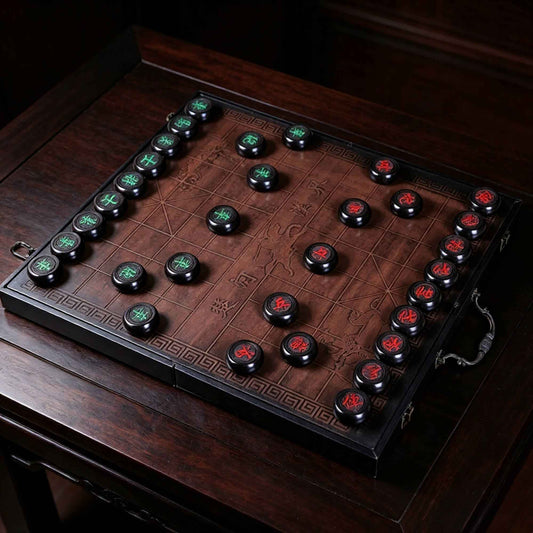
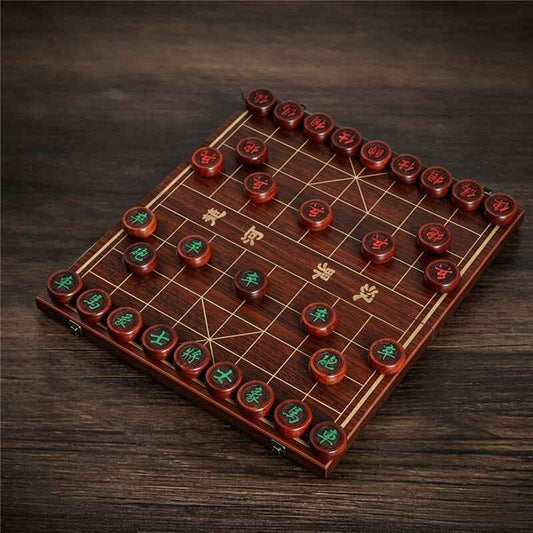
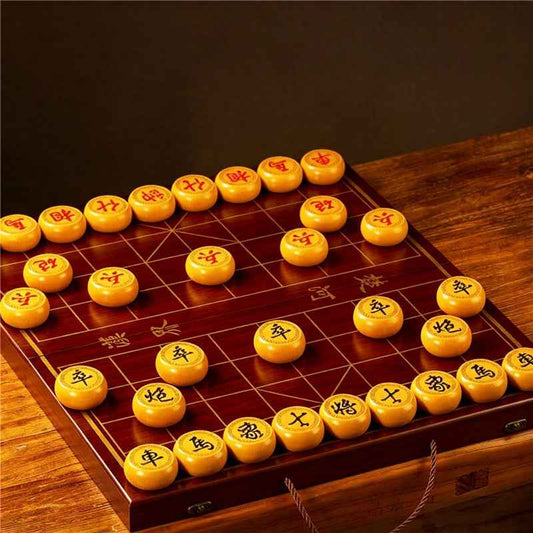
Chinese chess (xiangqi) is played on a different board, which is a 9×10 grid of line intersections with a central river. Pieces are not placed in squares, but on the intersections. Another variant of checkers, called international draughts, is played on a 10×10 board.
Some boards may appear similar on the surface, but have different layouts and playing requirements.
What are the colours of the squares and what colour should be put in the bottom-right corner?
The squares should be light and dark, and have sufficient contrast so that they can be easily distinguished. There must be a light square in the bottom right corner for each player.
The rules do not specify a particular colour combination, but are based on light and dark squares. Some popular combinations are cream and brown, buff and green or tan and walnut.
Matte finish and softer shades can help to minimize glare, especially when the lights are overhead.
Should a Chess Board be labelled with Coordinates?
No, the coordinate labels are not necessary to play chess and many chess boards don't have them.
The edges of the table are labeled with the names of the files (a–h) and the ranks (1–8). They can assist beginners to understand algebraic notation and facilitate the understanding of moves in books, lessons and online game logs.
For coordinates, opt for an easy-to-understand board without labels that obstruct the playing area.
What would happen if the squares on the chess board were too big or too small?
Too small squares can lead to a crowded board. Pieces can touch each other and it can be difficult to pick up a piece without disturbing the adjacent pieces.
If the pieces are too small for the squares, the board may appear to be empty and waste table space. Both mismatches have no effect on the usability of the board, but they do decrease playing comfort.
Before purchasing, check the base diameter of the king and compare it with the width of the square king. This is usually a better way to select a board than by its total size.
Are a 16-Inch Chess Board or 20-Inch Chess Board a Standard Size?
16" or 20" is not an official board size, but are common retail sizes.
A 16” board can be used with 2” (5.08 cm) squares and a 20” board can be used with 2.25” (5.72 cm) squares. Actual sizes will vary based on the border width and manufacturer's design.
There are some larger boards which have squares larger than FIDE's 6 cm. When planning to play on the board in a tournament, verify the size of the squares as well as the size of the board by reading the dimensions separately from the width advertised.
Conclusion
The standard chess board is 8 x 8 squares (64 squares) and tournament chess boards have a current technical standard of 5-6 cm per side. This results in a playing area of 40-48 cm on each side (excluding border).
For many serious players, a board measuring 5.5-5.7cm squares, and a commensurate Staunton set is a good option. The best fit however, is determined by the base diameter of the king, the proportions of the other pieces and the available space.
When purchasing, please look at the square size, overall dimensions of the board and piece base diameter. In the case of a set to be used in an official competition, check the current requirements for the equipment with FIDE or the national federation.